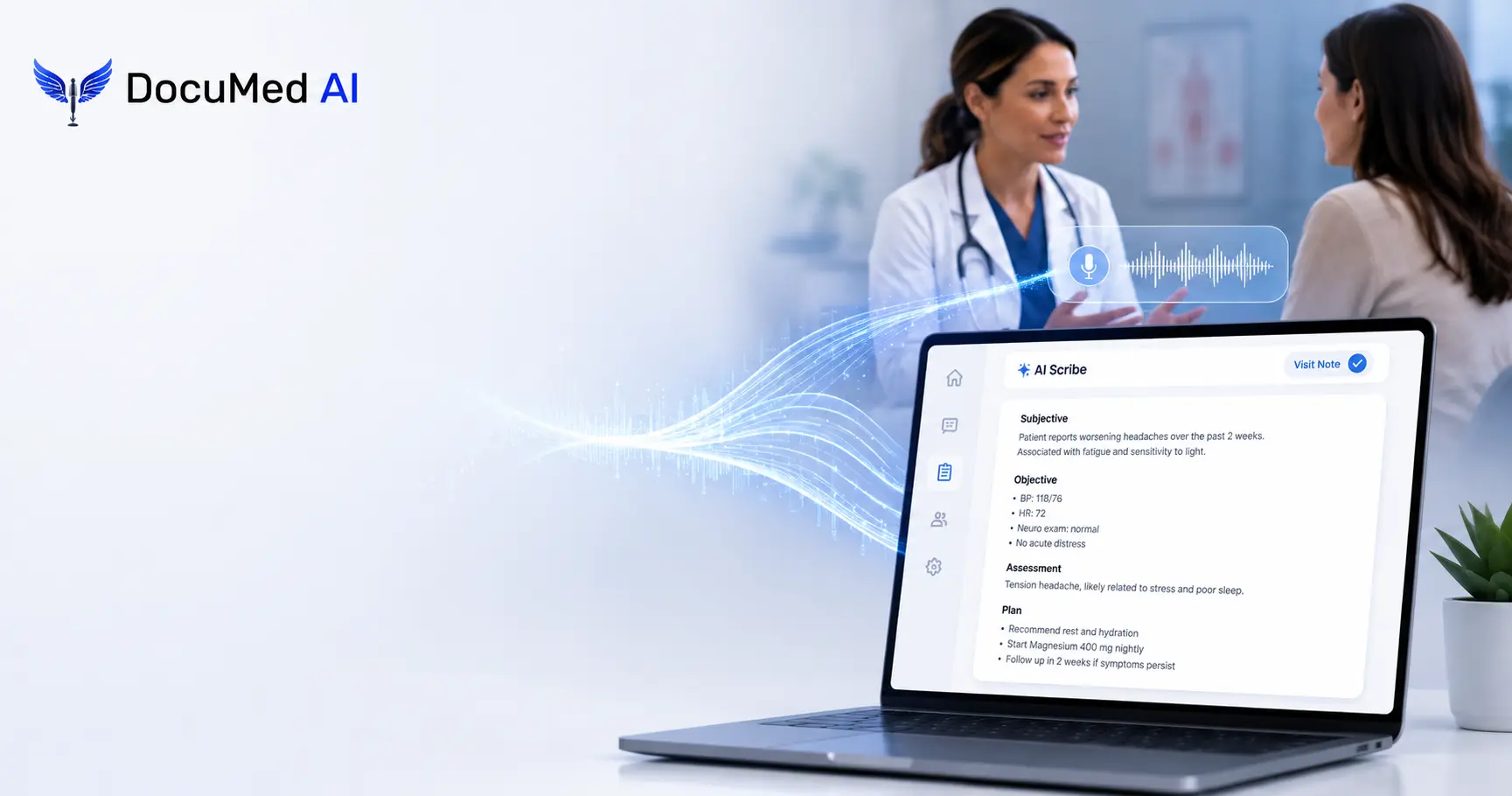
The phrase ambient clinical documentation shows up in almost every conversation about AI in medicine, often without a clear definition. It describes a specific idea: documentation that is generated from the natural conversation of a clinical visit, captured in the background, rather than typed by the clinician during or after the encounter. Federal health information technology resources from the Office of the National Coordinator, hosted at HealthIT.gov, have long framed the electronic health record as central to care, and ambient documentation is one of the newer attempts to make that record less of a burden to produce.
This guide explains what ambient clinical documentation is, how it works, how it differs from older approaches like dictation, and what clinicians should keep in mind. It is written for clinicians, practice managers, and anyone trying to understand the category. It is educational and does not replace clinical judgment or your organization's policies.
Ambient clinical documentation is the practice of creating a clinical note from the spoken interaction of a patient visit, captured passively while the clinician focuses on the patient. Instead of typing into a template or dictating a structured report, the clinician simply has the conversation. Software listens in the background, then drafts a structured note from what was said.
The word ambient is the key. The capture happens in the environment of the visit, without the clinician stopping to narrate to a machine. The output is a draft note that the clinician reviews, edits, and signs. The technology is often paired with an AI medical scribe, which is the tool that turns the captured conversation into a usable clinical document.
The workflow is straightforward from the clinician's side, even though the processing behind it is not. In broad terms:
The important design principle is that the clinician stays in control of the final note. The software produces a draft, not a signed document. Our overview of how it works describes this capture, draft, and review cycle in more detail, and our guide to an AI SOAP note generator shows how the same idea applies to a specific note format.
To understand what is new about ambient documentation, it helps to compare it to the two approaches that came before it.
The shift from dictation to ambient documentation is subtle but meaningful. Dictation moves the writing from fingers to voice. Ambient documentation removes the separate writing step during the visit and replaces it with a review step afterward.
The appeal is not just speed. It is attention. When a clinician is typing or mentally composing a note during a visit, part of their focus is on the record rather than the patient. Ambient documentation is designed to let the clinician stay present in the conversation, because the note is being captured without their active effort.
That has downstream effects that clinicians care about:
These benefits are why ambient documentation has become one of the most discussed tools for reducing documentation burden. Our guide to AI for EHR documentation looks at how that reduction plays out in the electronic health record specifically.
Ambient documentation is powerful, but it is not magic, and a few considerations matter.
A draft is a starting point. The clinician is responsible for reviewing it for accuracy and completeness before signing. Ambient tools reduce the effort of documentation; they do not remove the clinician's responsibility for it.
Capturing a clinical conversation means handling sensitive information. Any ambient tool should meet appropriate privacy and security standards, including a business associate agreement and clear data handling. Our guide to a HIPAA-compliant AI scribe explains what to verify before using one with patients.
Ambient documentation structures what was said. It does not diagnose, treat, or make clinical decisions. The value is in capturing the encounter accurately for the clinician to review, not in replacing clinical reasoning.
It means creating a clinical note from the natural conversation of a visit, captured passively in the background, rather than typing or dictating the note as a separate task. The clinician reviews and signs the resulting draft.
They are closely related. Ambient documentation is the approach of capturing the visit conversation, and an AI medical scribe is the tool that turns that conversation into a structured note. In practice the terms are often used together.
Dictation requires the clinician to compose and speak the note as a separate step. Ambient documentation drafts the note from the natural clinician-patient conversation, so the clinician's task becomes reviewing a draft rather than narrating one.
It can be, when the vendor meets appropriate standards. Because it captures clinical conversations, confirm that the tool offers a business associate agreement and clear data handling before using it with patient information.
Ambient clinical documentation is a simple idea with a meaningful effect: let the clinician have the conversation, and let the software draft the note. It moves documentation from an active task performed during the visit to a review task performed after it, which is why it has become central to the effort to reduce documentation burden. The essentials to keep in mind are clinician ownership of the note, privacy, and the understanding that the tool supports rather than decides.
If you want to see ambient documentation in your own workflow, DocuMed AI drafts the note from the visit so you can review instead of type. Book a demo, or see how it adapts across practice settings.
This article is for educational purposes only and is not clinical, legal, or compliance advice. Clinicians remain responsible for their documentation and for all clinical decisions.
Enjoy clinical practice again without the administrative burden. Start your free trial of DocuMed AI today.
SIGN UP NOWSubscribe to Our Newsletter for the Latest in Healthcare Innovation
.png)
DocuMed AI leverages advanced AI Scribe GPT technology to convert ambient sounds and physician-patient conversations into professional medical notes, seamlessly formatted for electronic medical records (EMRs).


.png)

.png)
.png)