.png)
The promise of the electronic health record was efficiency. What most physicians got instead was a second job.
Primary care physicians spend nearly 6 hours interacting with EHR systems across a single workday, with close to 2 hours of that happening after clinic hours. That is not a workflow problem. That is a structural one, and it has been accumulating for more than a decade.
A single documentation task can require 346 mouse clicks across 43 screens, according to one study. Patient history in one module. Medications in another. Notes somewhere else entirely. The EHR was designed to hold information, not to reduce the cost of entering it.
AI for EHR documentation is changing that equation. Not by replacing the physician's judgment, but by removing the administrative layer that sits between the clinical encounter and the finished chart.
The shift to digital records was supposed to streamline clinical workflows. In practice, the opposite happened for many physicians.
Of the average 57.8 hours a week that physicians work, only 27.2 hours are spent on direct patient care. Physicians report spending 13 hours on indirect care tasks including order entry, documentation, and referrals, and another 7.3 hours on administrative work such as prior authorization and insurance forms.
That math leaves very little room for the work that drew most physicians to medicine in the first place.
A study examining outpatient consultations found that documentation alone accounted for about 35 percent of physician time. A meta-analysis found that physicians' documentation workload rose from roughly 16 percent of total work time before electronic records to about 28 percent afterward, while nurses experienced a similar increase.
The EHR did not create documentation burden. It concentrated it, formalized it, and made it harder to delegate.
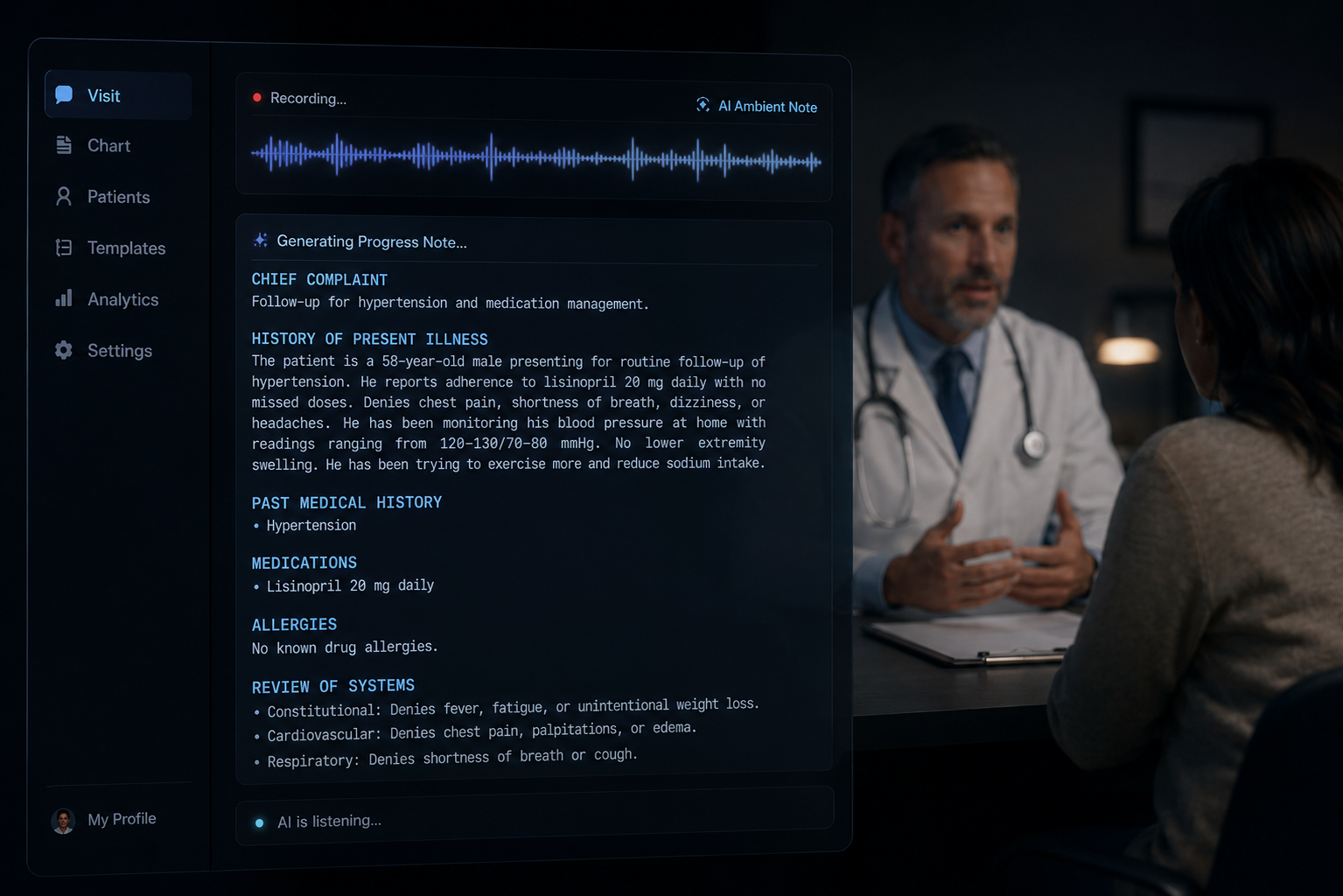
AI EHR documentation tools, specifically ambient AI scribes, address the problem at the source. Instead of asking physicians to enter data more efficiently, they remove most of the data entry requirement entirely.
The workflow is straightforward:
What changes is not the encounter itself but what happens after it. The physician does not carry a documentation debt from one patient into the next. The chart is ready to review, not ready to write.
DocuMed AI supports this workflow across all specialties and all practice settings, including outpatient clinics, inpatient environments, and telehealth platforms. Its library of over 100 customizable templates extends documentation coverage beyond progress notes to referral letters, after-visit summaries, discharge documentation, and medical reports, capturing the full administrative scope of a clinical day.
The research on AI EHR documentation has moved well beyond anecdotal reports. Multiple peer-reviewed studies now quantify the impact.
A study across five major US health systems found that using an AI scribe led clinicians to spend about 13 fewer minutes in the EHR and 16 fewer minutes on documentation per 8-hour day, while also seeing slightly more patients.
A study evaluating one AI documentation tool with 57 clinicians found a significant drop in documentation time per encounter from 6.2 to 5.3 minutes. A separate controlled trial reported that another tool reduced documentation time per visit from 5.3 to 4.54 minutes.
Across a full week of clinical practice, those per-encounter savings compound into hours. For most physicians using DocuMed AI, the recovered time reaches 40 hours per month. That figure reflects what the platform consistently sees across its user base.
The financial dimension is also real. A JAMA Network Open analysis of more than 1.2 million ambulatory encounters found that AI scribe adopters generated 1.81 additional relative value units and saw roughly one more patient per week, with no increase in claim denials, compared to non-adopters.
Physicians evaluating EHR documentation software will encounter several categories of tools. The distinction matters.
Traditional EHR charting tools, templates, macros, and structured input forms, reduce the time spent typing but still require the physician to navigate the EHR, select options, and manage the note structure. The cognitive load stays largely intact.
Ambient AI documentation tools operate differently. They remove the input burden rather than just streamlining it. The physician speaks naturally with their patient. The AI handles the translation from conversation to structured clinical note.
The key criteria when evaluating AI EHR documentation software:
DocuMed AI meets all of these. Built by practicing physicians, the platform was developed around real clinical workflows rather than adapted from general-purpose transcription technology. That distinction shows in note quality and in how little editing physicians need to do before signing.

One friction point that slows AI documentation adoption is the assumption that it requires behavioral change. Physicians worry about adjusting how they speak, how they structure patient encounters, or how they interact with their existing EHR.
With modern ambient AI, that concern does not hold. The tool works within the encounter as it already exists. There is no new vocabulary to learn, no dictation protocol to follow, no prompt structure required.
DocuMed AI requires no training to get started. The interface activates at the beginning of a session and the physician gets a review-ready draft within minutes of the encounter ending. The learning curve for most clinicians is measured in days, not weeks.
AI adoption among physicians rose from 47% in early 2025 to 63% by early 2026, a 16-point increase in under a year, with voice-based documentation tools being the fastest-growing use case. The physicians who have adopted are not outliers or early-adopter enthusiasts. They are generalists, specialists, and solo practitioners who reached a point where the documentation burden cost more than the solution.
Q: What is AI EHR documentation?
AI EHR documentation refers to software that automates the creation of clinical notes by capturing and transcribing physician-patient conversations, then structuring the output into a chart-ready format for the EHR. It removes most of the manual data entry from post-encounter documentation.
Q: Does AI EHR documentation software integrate with my EHR?
Most platforms, including DocuMed AI, support a copy-paste workflow that is compatible with any EHR. Some offer deeper native integrations with systems like Epic, athenahealth, and eClinicalWorks. For practices with specific EHR requirements, confirming integration depth before selecting a tool is important.
Q: How accurate is AI clinical documentation?
Clinical accuracy at the leading platforms now exceeds 99%. DocuMed AI is designed to understand medical terminology across specialties, capturing the clinical detail of an encounter accurately enough that most physicians make minimal edits before signing. Reviewing every note before finalization remains standard practice regardless of the tool.
Q: Is AI EHR documentation software HIPAA compliant?
HIPAA compliance is a baseline requirement in this category. DocuMed AI processes all audio through secure servers and is fully HIPAA compliant from capture through export. Any platform being evaluated for clinical use should provide a Business Associate Agreement as part of onboarding.
Q: How much time can AI for electronic health records actually save?
Research across large US health systems indicates that AI scribe adoption reduces EHR and documentation time by 13 to 16 minutes per 8-hour clinical day, per encounter. Across a full month, DocuMed AI users report recovering approximately 40 hours that were previously absorbed by documentation.
Q: Does it work for all medical specialties?
DocuMed AI supports all medical specialties including primary care, cardiology, neurology, psychiatry, endocrinology, nephrology, rheumatology, surgery, and emergency medicine. The AI adapts to specialty-specific terminology and note structures rather than applying a generic template.
The EHR is not going away. The documentation burden that came with it does not have to stay.
AI EHR documentation tools have reached a level of accuracy, security, and workflow compatibility that makes adoption practical for practices of any size. The research supports it. The clinical outcomes reflect it. The only remaining variable is when each practice decides the time savings are worth acting on.
DocuMed AI offers a free trial with no training required. Start a session, see the note it produces, and decide from there.
Enjoy clinical practice again without the administrative burden. Start your free trial of DocuMed AI today.
SIGN UP NOWSubscribe to Our Newsletter for the Latest in Healthcare Innovation
.png)
DocuMed AI leverages advanced AI Scribe GPT technology to convert ambient sounds and physician-patient conversations into professional medical notes, seamlessly formatted for electronic medical records (EMRs).


.png)

.png)
.png)