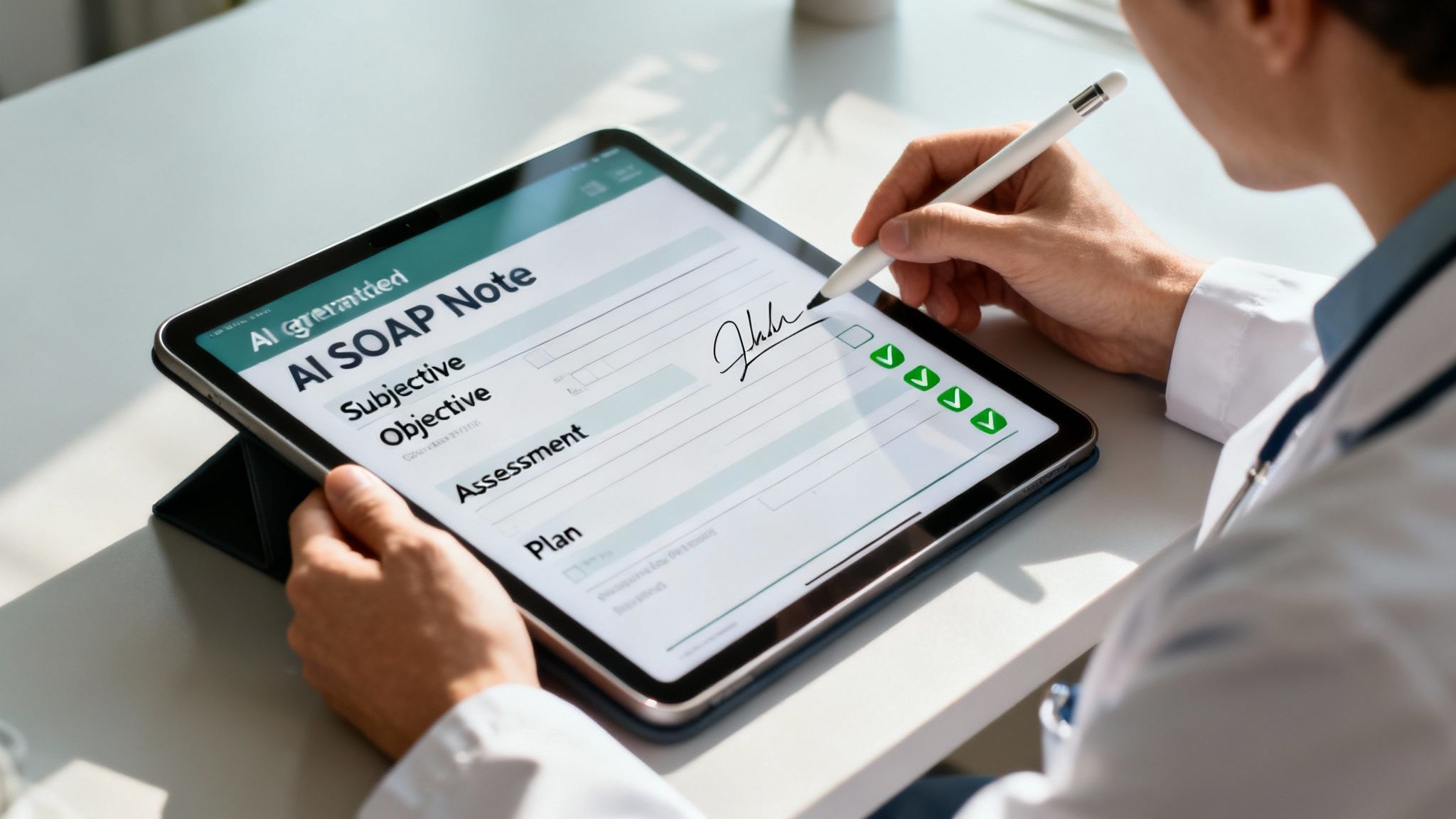
An AI SOAP note generator helps clinicians turn a patient encounter into a structured clinical note using the SOAP format: Subjective, Objective, Assessment, and Plan.
Instead of writing the note from scratch, the clinician can use AI to create a first draft, then review, edit, and approve the final documentation.
A good AI SOAP note generator should save time without removing clinical judgment. It should help with structure, consistency, and documentation speed while keeping the clinician in control.
This guide explains how AI SOAP note generators work, what they can help with, what to check before using one, and how to use AI safely in clinical documentation.
An AI SOAP note generator is a tool that helps create SOAP notes from clinical information.
Depending on the tool, it may work from:
The AI then organizes the information into the SOAP format:
The result should be a structured draft that the clinician can review and edit before adding it to the medical record.
SOAP stands for:
Each section has a different purpose.
Subjective includes what the patient reports.
This may include:
Objective includes what the clinician observes, measures, or verifies.
This may include:
Assessment explains the clinician’s impression or reasoning.
This may include:
Plan explains what happens next.
This may include:
Most AI SOAP note generators follow a simple workflow.
The tool starts by capturing clinical information.
This may happen through:
The better the input, the better the draft.
The AI looks for important clinical information, such as:
It then separates information that belongs in Subjective, Objective, Assessment, and Plan.
The AI organizes the encounter into a structured note.
A useful draft should be:
The goal is not to create a perfect final note automatically. The goal is to reduce the amount of typing and organizing the clinician has to do.
The clinician should always review the note before signing.
This step matters because AI can:
A safe workflow keeps the clinician as the final reviewer.
Not every AI SOAP note generator is equally useful. The best tools are designed around real clinical workflows, not just generic text generation.
Look for these qualities.
The tool should separate the note into:
It should not simply produce a long paragraph or transcript.
A useful AI SOAP note generator should capture the important parts of the encounter clearly.
Check whether it includes:
The draft should be easy to review and edit.
A good tool should help the clinician move faster, not create a note that needs to be rewritten from scratch.
Different specialties document differently.
A strong AI SOAP note generator should support different clinical settings, such as:
Any tool that handles patient information should support privacy-conscious healthcare workflows.
Before using an AI tool with real patient data, clinicians should check:
The tool should fit the way the clinician already works.
Ask:
A SOAP note template gives the clinician a structure to fill in manually.
An AI SOAP note generator helps draft the content inside that structure.
Best for:
A template is useful, but the clinician still has to write the note.
Best for:
An AI generator can save time, but the clinician still needs to review the final note.
Both can work together. The template defines the structure, and the AI helps fill it.
The terms are related, but they are not always the same.
An AI SOAP note generator focuses specifically on creating SOAP notes.
It may work from:
An AI medical scribe is usually broader. It may listen to the encounter and create different types of clinical notes, such as:
An AI medical scribe may include SOAP note generation as one of its main features.
Here is a simple example of how a clinician might use an AI SOAP note generator.
The clinician completes the patient encounter as usual.
The patient describes symptoms, the clinician asks follow-up questions, performs an exam, discusses an assessment, and gives a plan.
The AI organizes the visit into SOAP format.
It may draft:
The clinician checks:
The clinician makes corrections and approves the final note.
This keeps the workflow safe and clinician-led.
Fictional example only. This is not a real patient and contains no real protected health information. It is for educational purposes only and should not be used as medical advice.
Patient reports a three-day history of sore throat, dry cough, and mild fatigue. Cough is worse at night. Patient reports low-grade fever at home. Patient denies chest pain, shortness of breath, wheezing, or known chronic lung disease. No medication allergies reported.
Patient appears tired but in no acute distress. Oxygen saturation is normal on room air. Throat mildly erythematous without exudate. Lungs clear bilaterally. No wheezing or crackles noted. Heart rate regular.
Acute cough and sore throat, most consistent with viral upper respiratory infection. Bacterial pharyngitis is less likely based on lack of exudate and lack of significant lymph node findings. Pneumonia is less likely given normal oxygen saturation and clear lung exam.
Recommend supportive care with fluids, rest, and symptom relief as appropriate. Reviewed warning signs including shortness of breath, chest pain, persistent fever, worsening symptoms, or symptoms lasting longer than expected. Patient advised to follow up if symptoms do not improve or if new concerning symptoms develop.
Before using an AI SOAP note generator, check these areas.
Generic AI tools may not be built for clinical documentation.
A healthcare-focused tool should understand:
If the tool handles patient information, privacy matters.
Ask:
The clinician should always be able to review, edit, and approve the final note.
Avoid workflows that make the AI-generated note feel final without clinician review.
A useful AI SOAP note generator should support the way your specialty documents care.
For example:
Ask how the note gets into the chart.
Options may include:
The best option depends on your practice size, EHR, and documentation process.
Pricing should be easy to understand.
Check:
A good AI SOAP note generator can help clinicians save time and reduce repetitive documentation work.
Potential benefits include:
The biggest benefit is often not just speed. It is reducing the mental burden of turning every visit into a polished clinical note from scratch.
AI tools can help, but they are not perfect.
Common limitations include:
Clinicians should treat AI-generated SOAP notes as drafts, not final documentation.
The clinician should always review the final note.
AI can help draft documentation, but it should not replace clinician responsibility.
If the AI tool uses prompts, vague input can create vague notes.
More specific clinical input usually creates a better draft.
A generic SOAP note may not fit every specialty. Templates should match the setting and visit type.
Before using any AI tool with real patient information, confirm privacy, compliance, and data-handling terms.
Longer is not always better. A SOAP note should be complete, but it should also be readable and clinically useful.
When comparing tools, ask:
A good AI SOAP note generator should make clinical documentation easier without making the workflow more complicated.
An AI SOAP note generator is a tool that helps create structured SOAP notes using AI. It organizes clinical information into Subjective, Objective, Assessment, and Plan sections.
AI can help draft SOAP notes, but the clinician should review, edit, and approve the final note before it becomes part of the medical record.
Not always. An AI SOAP note generator focuses on SOAP notes. An AI medical scribe may create SOAP notes plus other documentation types, such as progress notes, consultation notes, and summaries.
AI SOAP notes can be useful first drafts, but they are not perfect. Accuracy depends on input quality, audio quality, visit complexity, specialty language, and clinician review.
No. AI can help with documentation, but it does not replace clinical judgment. The clinician remains responsible for the final note.
It can be safe when the tool is designed for healthcare, supports privacy requirements, allows clinician review, and fits the practice’s workflow. Clinicians should confirm compliance and data-handling terms before using any AI tool with patient information.
Some AI SOAP note generators can support behavioral health documentation, but therapists may also use formats like DAP or BIRP depending on their workflow.
Check healthcare focus, HIPAA support, BAA availability, data policy, specialty fit, editing controls, EHR workflow, pricing, and trial availability.
An AI SOAP note generator can help clinicians create structured documentation faster, but it should be used thoughtfully.
The best tools do not replace the clinician. They reduce typing, organize information, and create a useful first draft that the clinician reviews and approves.
If SOAP note documentation is taking too much time, DocuMed AI can help clinicians draft structured notes faster while keeping the clinician in control. See how DocuMed AI works or book a demo to learn how AI can support your SOAP note workflow.
For more updates on AI medical scribes, SOAP notes, clinical documentation, and healthcare workflow automation, follow DocuMed AI on LinkedIn, Facebook, Instagram, and YouTube.
Stay connected for practical tips, product updates, and simple guides that help healthcare teams reduce documentation time and improve their clinical workflow.
Enjoy clinical practice again without the administrative burden. Start your free trial of DocuMed AI today.
SIGN UP NOWSubscribe to Our Newsletter for the Latest in Healthcare Innovation
.png)
DocuMed AI leverages advanced AI Scribe GPT technology to convert ambient sounds and physician-patient conversations into professional medical notes, seamlessly formatted for electronic medical records (EMRs).


.png)

.png)
.png)