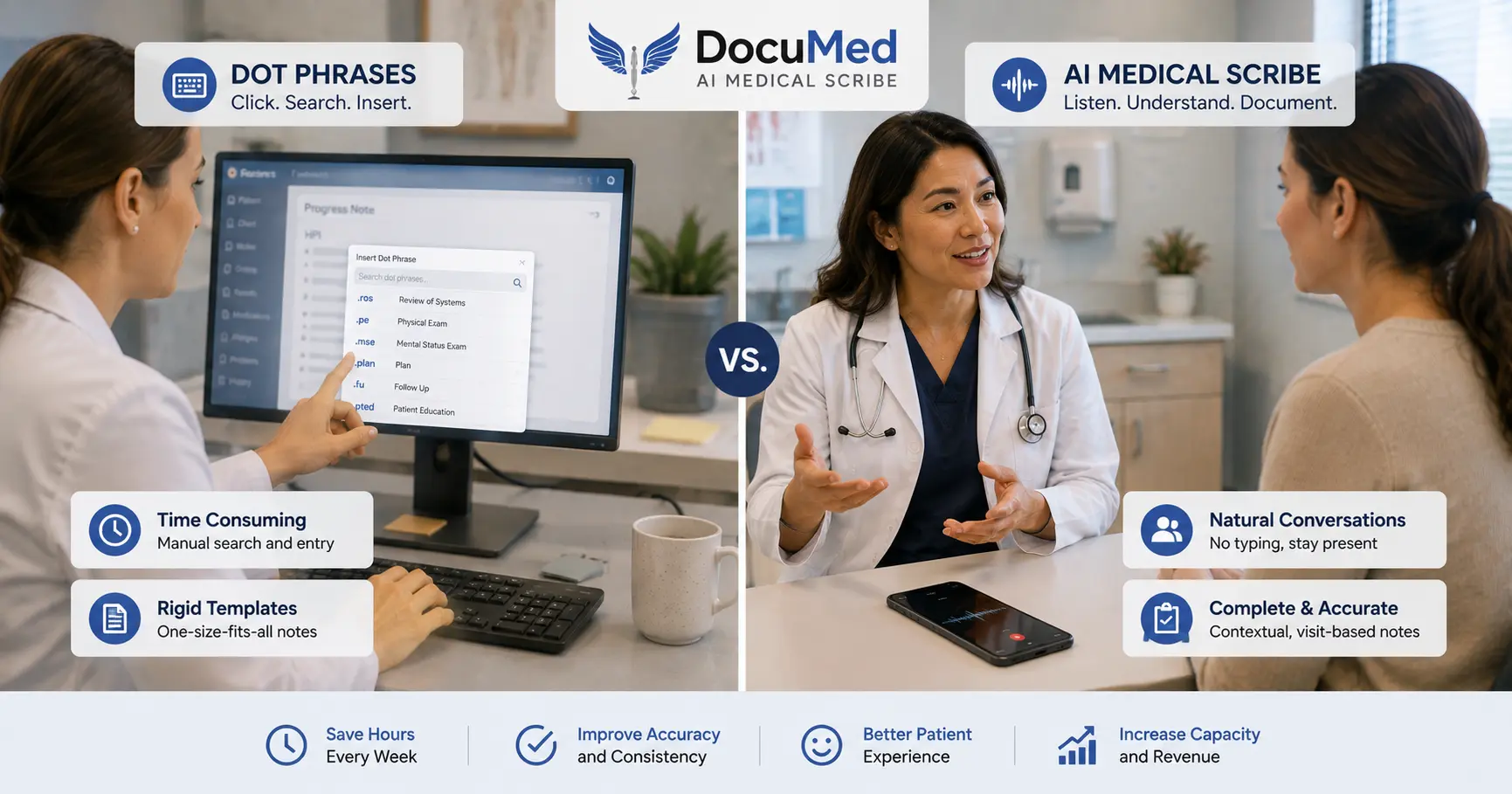
Dot phrases and templates save time on typing. An ambient AI scribe saves time on the whole documentation process, from capturing what actually happened in the room to producing a note that is ready for a quick review. They are not really competing for the same job. Dot phrases speed up text entry. An AI scribe replaces the manual note-writing step entirely. Used together, they tend to save more time than either one alone, and that combination, not a winner-take-all choice, is where most practices end up.
The stakes are real. Physicians already spend a disproportionate share of the office day on documentation. Sinsky and colleagues found that physicians spent about 49 percent of the office day on EHR and desk work, compared with about 27 percent on direct patient care, roughly two hours of EHR and desk work for every hour spent with patients (Sinsky CA, et al., Annals of Internal Medicine, 2016). Dot phrases were built to claw back some of that time. Ambient AI scribes are a newer attempt at the same problem, from a different angle. Here is how they actually compare.
Dot phrases, SmartPhrases, macros, and note templates are all versions of the same idea: a short trigger, typically a keyboard shortcut or a dot-prefixed code, that inserts a pre-written block of text into the note. Epic calls them SmartPhrases, other EHRs call them macros or auto-text, and "template" usually refers to the larger structured skeleton a note is built on. Functionally, they all do the same job: they let a clinician avoid retyping the same sentence, paragraph, or exam block over and over.
None of this makes dot phrases a bad tool. It makes them a tool built for one specific job: fast, consistent insertion of language that does not change much visit to visit. That is a narrower job than documenting the whole encounter.
An ambient AI scribe works differently from the ground up. With DocuMed AI's workflow, the clinician presses record and conducts the visit normally, or uploads an audio file of the encounter. The audio is encrypted and processed by DocuMed's AI model, and a structured clinical note appears within seconds. The clinician then reviews, edits, and customizes that note before copying it and pasting it into any EHR. The clinician stays fully in the loop at every step; the AI drafts, the clinician decides what stays.
A fair comparison has to admit where templates and macros are still the better tool:
This is the same tradeoff explored from a different angle in DocuMed's comparison of dictation versus AI scribing: different documentation methods are suited to different moments in a visit, not to every moment equally.
The most common misconception in this comparison is that choosing an AI scribe means giving up templates. It does not. A well-built AI scribe still relies on templates, it just uses them differently. DocuMed AI ships with 100+ customizable note and document templates, along with custom assessment styles, and the platform adapts to a clinician's own documentation style over time. The template supplies the structure a specialty or service needs. The AI fills that structure with the specific content of the actual visit, instead of a clinician manually assembling it from a library of dot phrases in real time.
Templates can also be shared across a team or service, which delivers the consistency dot phrases were originally meant to provide, but populated from what really happened in each encounter rather than from reused blocks. For follow-on documentation tasks, DocuMed's AI-chat assistant can take a finished note and generate related documents from it, such as a referral letter drafted from the base note. And the physician-in-the-loop step never disappears: the clinician always reviews, edits, and customizes the note before copying it into the EHR. Nothing files itself. For a broader look at how AI scribes stack up against manual documentation approaches generally, see DocuMed's guide to choosing the best AI medical scribe.
Instead of picking a single winner, match the tool to the situation:
In practice, most clinicians end up using both: an AI scribe for the bulk of the note, and a small number of retained template lines for language that genuinely needs to stay fixed.
They are close enough to treat as one category for comparison purposes. SmartPhrases is Epic's name for dot phrases, other EHRs call similar features macros or auto-text, and "template" usually refers to the larger structured note skeleton these phrases get inserted into. All of them are reusable, pre-written text triggered by the clinician.
No. DocuMed AI includes 100+ customizable templates and custom assessment styles as part of the platform. The AI generates the visit-specific content; the template still provides the structure.
Generally less, not more. Note bloat is largely driven by stacking pre-written blocks and copy-forwarding old text. An ambient AI scribe drafts from the actual conversation, so the starting point is what was discussed in that visit rather than an accumulation of prior blocks. See DocuMed's dedicated piece on why notes balloon in length for more on how that pattern develops.
Yes, always. DocuMed AI is built around clinician review: the note is generated in seconds, the clinician reviews and edits it, and only then copies it into the EHR. The tool does not file notes on its own and does not remove the need for clinical judgment.
Yes. During the review and edit step, a clinician can add, adjust, or keep any fixed language they need, including standard phrases for required disclosures or instructions, before copying the finished note into the EHR.
DocuMed AI combines ambient AI scribing with 100+ customizable templates so clinicians get structure and individualized notes in the same workflow. Start a free DocuMed AI account to try it on your own visits.
Enjoy clinical practice again without the administrative burden. Start your free trial of DocuMed AI today.
SIGN UP NOWSubscribe to Our Newsletter for the Latest in Healthcare Innovation
.png)
DocuMed AI leverages advanced AI Scribe GPT technology to convert ambient sounds and physician-patient conversations into professional medical notes, seamlessly formatted for electronic medical records (EMRs).


.png)

.png)
.png)