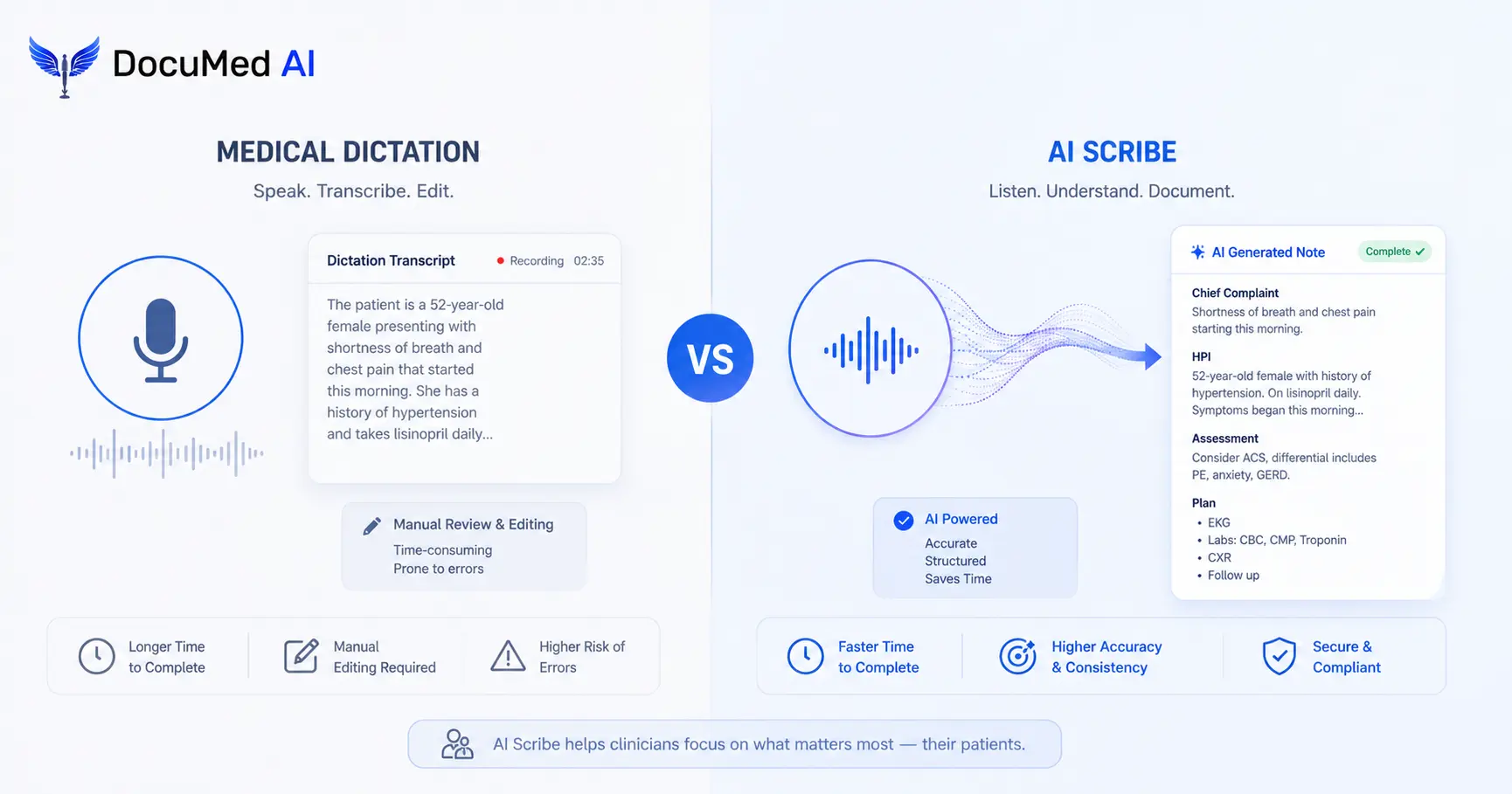
For decades, the fastest way to get a note out of a clinician's head and into the chart was to speak it. Medical dictation, whether transcribed by a person or by speech recognition software, has been a fixture of clinical documentation. Now a newer approach, the AI medical scribe, is changing what speaking your notes means. The two are easy to confuse because both involve talking instead of typing, but they work differently and suit different needs.
This guide compares medical dictation and AI scribes: how each works, where each is strong, and how clinicians can decide between them. It is written for clinicians and practice managers evaluating documentation tools. It is educational and does not replace your organization's policies or clinical judgment.
Medical dictation is the practice of composing a clinical note by speaking it aloud. The clinician narrates the note, structuring the content as they go, and the spoken words are turned into text, either by a transcriptionist or by speech recognition software.
The defining feature of dictation is that the clinician is still the author of the note in real time. They decide the structure, the wording, and the order, and they speak it as a deliberate act of composition. Dictation replaces typing with talking, but the clinician is still actively writing the note, just with their voice.
An AI medical scribe takes a different approach. Instead of the clinician narrating a note, the tool captures the natural conversation of the visit and drafts a structured note from it. The clinician has the conversation with the patient, and the software produces a draft afterward for review.
The defining feature of an AI scribe is that the clinician is not composing the note during the encounter. The note is generated from the visit itself, and the clinician's role shifts to reviewing and editing a draft rather than authoring one from scratch. This is often called ambient documentation, because the capture happens in the background of the visit. Our overview of how it works walks through the process.
The distinction comes down to who composes the note and when.
Everything else, the strengths and trade-offs, flows from that single difference.
Our guide to the best AI medical scribe features describes what strong note quality looks like, and our comparison of an AI medical scribe and a virtual scribe covers a related choice clinicians often weigh at the same time.
The honest answer is that it depends on the clinician and the setting.
Dictation may suit a clinician who wants complete, word-level control over the note, who documents encounters that are not conversational, or who already has an efficient dictation workflow they are happy with. Some procedural and specialty contexts lend themselves to a narrated report more than a captured conversation.
An AI scribe may suit a clinician whose visits are conversational, who wants to stay present with the patient rather than compose a note, and who would rather review a structured draft than narrate one after the visit. For high-volume outpatient practice, the reduction in separate documentation work is often the deciding factor. Our guide to AI for EHR documentation looks at how that reduction plays out in the electronic health record.
The two are not mutually exclusive. Some clinicians use ambient capture for conversational visits and dictation for specific report types. The right mix depends on the work.
Whichever tool is used, two things stay constant. First, the clinician is responsible for the final note. A dictated note has to be reviewed for transcription errors, and an AI-drafted note has to be reviewed for accuracy before signing. Second, any tool that handles patient information should meet appropriate privacy and security standards, including a business associate agreement and clear data handling. Our guide to a HIPAA-compliant AI scribe explains what to verify, and the same diligence applies to dictation vendors.
With dictation, the clinician composes the note by speaking it, and the tool transcribes their words. With an AI scribe, the tool drafts the note from the natural visit conversation, and the clinician reviews the draft. Dictation keeps the clinician as author; an AI scribe makes them the editor.
Neither is universally better. An AI scribe removes the separate composition step and helps the clinician stay present, while dictation gives word-level control over the note. The best choice depends on the clinician's visits, preferences, and workflow.
Yes. Some clinicians use ambient capture for conversational visits and dictation for specific report types. The approaches are not mutually exclusive, and a mix can fit a practice with varied documentation needs.
Yes. A dictated note needs review for transcription errors, and an AI-drafted note needs review for accuracy. In both cases the clinician is responsible for the final note before it is signed.
Medical dictation and AI scribes both let clinicians talk instead of type, but they solve the problem differently. Dictation keeps the clinician composing the note, with full control and a separate step after the visit. An AI scribe drafts the note from the visit itself, shifting the clinician from author to editor and helping them stay present with the patient. Neither is universally right; the fit depends on the work, and some clinicians use both.
If you are weighing how to spend less time writing notes, DocuMed AI drafts documentation from the visit so you can review instead of compose. Book a demo, or compare plans on our pricing page.
This article is for educational purposes only and is not clinical, legal, or compliance advice. Clinicians remain responsible for their documentation and for all clinical decisions.
Enjoy clinical practice again without the administrative burden. Start your free trial of DocuMed AI today.
SIGN UP NOWSubscribe to Our Newsletter for the Latest in Healthcare Innovation
.png)
DocuMed AI leverages advanced AI Scribe GPT technology to convert ambient sounds and physician-patient conversations into professional medical notes, seamlessly formatted for electronic medical records (EMRs).


.png)

.png)
.png)