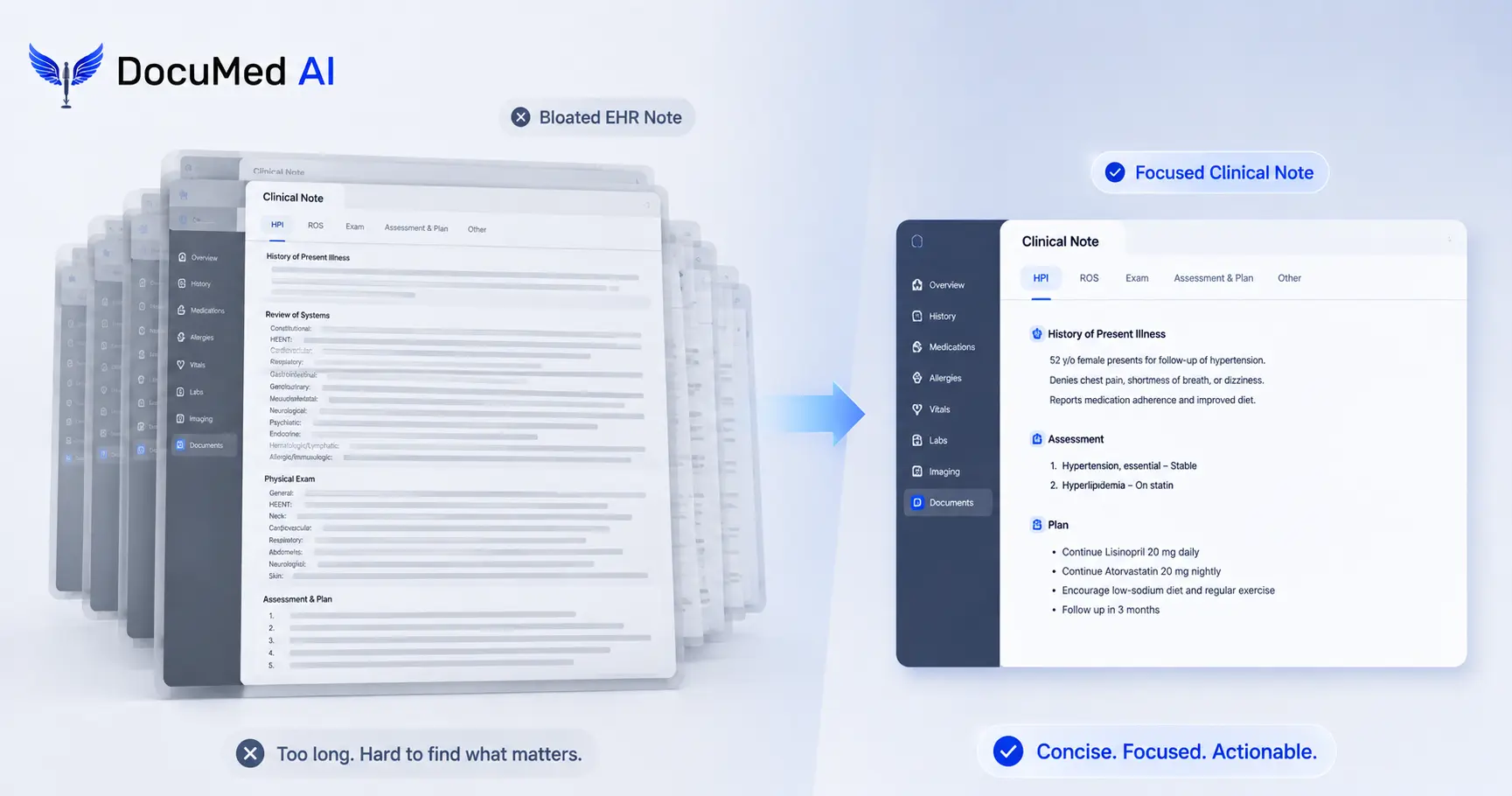
Open a long-standing patient chart in almost any electronic health record and you will likely find notes that are several pages long but say very little. The relevant clinical detail is buried under repeated history, carried-forward lists, and text that was pasted from a previous visit. This is note bloat, and it is one of the most common quality problems in modern clinical documentation. Federal resources on electronic health records at HealthIT.gov have emphasized for years that a record is only useful if clinicians can find the information they need in it, and note bloat works directly against that goal.
This guide explains what note bloat is, why it happens, the risks it creates, and how to reduce it. It is written for clinicians, documentation specialists, and practice managers. It is educational and does not replace your organization's documentation policies or clinical judgment.
Note bloat is the tendency of clinical notes to grow long without growing more useful. The note contains a large volume of text, but the signal, the specific clinical reasoning and findings that matter for this encounter, is hard to locate within it.
Bloated notes are usually not the result of a clinician trying to be thorough. They are a side effect of tools designed to save time: copy-forward functions, templated text, and automatic data pulls. Each of these can be helpful in moderation. Used heavily, they fill the note with content that is technically present but practically noise.
Understanding the causes is the first step to reducing it. A few features of electronic documentation drive most note bloat.
The ability to carry a previous note forward is a major time-saver, and a major source of bloat. When yesterday's note becomes the skeleton of today's, outdated information travels with it. Over time, the note accumulates layers of text that no longer reflect the patient in front of you.
Templates ensure consistency, but they also insert large blocks of standard text whether or not it is relevant. Auto-populated data, such as full medication lists or complete review-of-systems checklists, adds length that a reader has to wade through to reach the clinician's actual assessment.
When documentation feels like it exists to satisfy billing or audit requirements, the temptation is to add volume as a form of protection. More text can feel safer. In reality, padding a note does not strengthen it, and it can obscure the medical necessity that good documentation is supposed to show.
A long note seems harmless, but bloat carries real costs.
In other words, note bloat does not just make notes longer. It makes the record less reliable, which is a clinical problem, not just a stylistic one.
Reducing bloat does not mean documenting less. It means documenting what matters, clearly. A few habits and practices help.
These habits also support cleaner coding and quality reporting, because specific, accurate documentation is what those processes depend on. Our guide to AI for EHR documentation looks at how reducing the friction of charting can also reduce the temptation to pad.
AI documentation tools have a complicated relationship with note bloat. Used well, they can reduce it. Used carelessly, they can add to it.
On the helpful side, an AI medical scribe drafts a note from the actual encounter, which means the content reflects what happened in this specific visit rather than what was carried forward from the last one. Because the clinician starts from a fresh, encounter-specific draft, there is less reason to lean on copy-forward. The task becomes reviewing an accurate draft rather than editing an inherited one. Our guide to the best AI medical scribe features describes what to look for in a tool that produces focused, specific notes.
On the cautionary side, any tool that can generate text quickly can generate too much of it. The safeguard is the same as it has always been: the clinician reviews the note and keeps it focused. AI drafts the note; the clinician decides what stays. A tool that produces a clean, specific draft is an ally against bloat, but only if the clinician still edits for signal. For a refresher on how a well-structured note keeps content focused, see our complete guide to SOAP notes.
Note bloat is the tendency of clinical notes to become long without becoming more useful. The important clinical detail is buried under repeated, templated, or copied-forward text, which makes the note harder to read and less reliable.
The main causes are copy-forward and copy-paste functions, heavy use of templates and auto-populated data, and the habit of adding text to satisfy billing or audit concerns. Each can be helpful in moderation but drives bloat when overused.
It can hide clinically important information, waste the time of everyone who reads the note, allow errors to propagate through copy-forward, and weaken the integrity of the record. A bloated note is less trustworthy and harder to defend.
They can, because they draft a note from the actual encounter rather than carrying old text forward, which reduces reliance on copy-forward. The clinician still needs to review and keep the note focused, since any text-generating tool can add length if unchecked.
Note bloat is what happens when tools meant to save time end up filling the record with noise. The cost is real: buried detail, wasted time, propagated errors, and a weaker record. The fix is not to document less but to document with intent, writing the reasoning fresh, using copy-forward sparingly, and favoring specificity over volume. Used carefully, AI documentation can help by producing focused, encounter-specific drafts that reduce the pull toward copied text.
If your notes are longer than they are useful, DocuMed AI drafts focused documentation from the visit for you to review. See how it works, or book a demo.
This article is for educational purposes only and is not clinical, coding, or compliance advice. Follow your organization's documentation policies and applicable guidance.
Enjoy clinical practice again without the administrative burden. Start your free trial of DocuMed AI today.
SIGN UP NOWSubscribe to Our Newsletter for the Latest in Healthcare Innovation
.png)
DocuMed AI leverages advanced AI Scribe GPT technology to convert ambient sounds and physician-patient conversations into professional medical notes, seamlessly formatted for electronic medical records (EMRs).


.png)

.png)
.png)