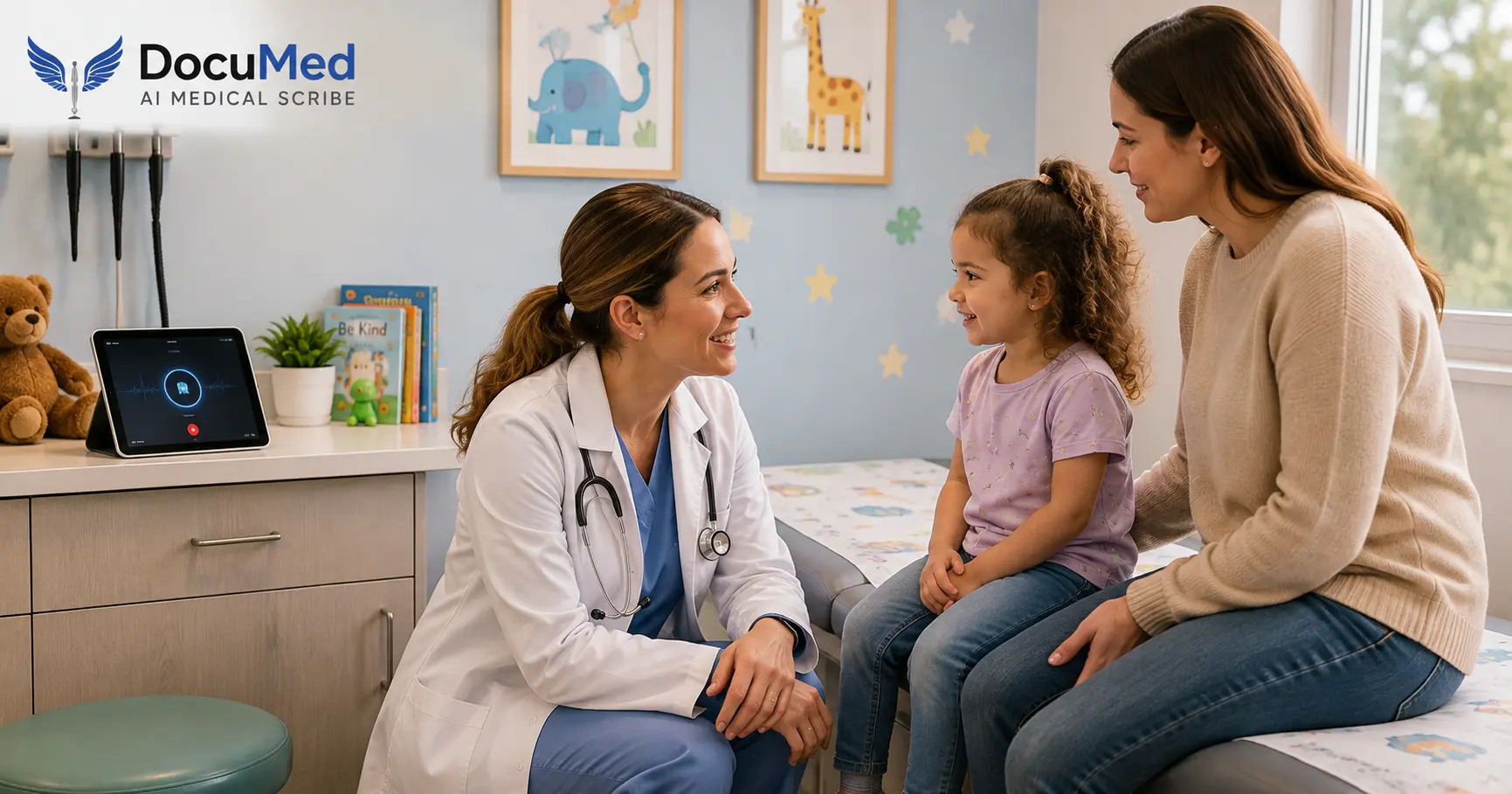
An AI medical scribe for pediatrics listens to the visit, drafts a structured note in the clinician's own style, and hands it back for review before anything is finalized. That workflow matters more in pediatrics than in most specialties: a single well-child visit can involve a child, one or two caregivers, a growth chart, an immunization schedule, and a set of age-specific anticipatory guidance topics, all inside a 15 to 20 minute slot. For clinicians researching an AI scribe for pediatricians, the fit usually comes down to three things: staying present with the child and caregiver instead of the screen, templates that match how pediatric visits are actually structured, and being able to trust the record afterward. DocuMed AI, an ambient AI medical scribe, is built around all three.
Pediatric visits are not shorter versions of adult visits. They carry structural requirements that most other specialties don't have to juggle at every single encounter.
Get any one of these wrong under time pressure: a stale weight used for a dose calculation, a missed immunization due date, or a growth trend that doesn't get flagged, and the consequences are more concrete than an incomplete adult progress note. None of this comes down to typing speed. Documentation burden is a well-studied problem across specialties: research published in the Annals of Internal Medicine found that physicians spend close to two hours on EHR and desk work for every hour of direct patient care (Sinsky CA, et al., 2016). In pediatrics, that time gets compressed further because a single note has to hold growth data, immunization status, developmental findings, and caregiver counseling on top of the visit's actual chief complaint.
DocuMed AI records the visit the way it naturally happens. The clinician presses record and conducts the exam as usual, talking with the caregiver, getting down to the child's level, or narrating findings out loud, without stopping to type. Uploaded audio is also supported for visits recorded a different way. The audio is encrypted and processed by DocuMed's AI model, and a structured clinical note appears within seconds after the visit ends. Because DocuMed AI runs on mobile, tablet, and web, there's no laptop screen sitting between the clinician and a child who's already unsure about being at a doctor's office.
That matters clinically. In pediatrics, eye contact and physical presence often make the difference between a cooperative exam and a distressed one. A clinician who isn't narrating to a screen or clicking through fields mid-visit can stay focused on the child's affect, the caregiver's concerns, and the exam itself. DocuMed AI reports 99%+ clinical accuracy on the notes it generates, which is what makes it reasonable to step away from real-time typing in the first place: the note still reflects what was said and done, and the clinician reviews it afterward instead of building it live.
AI documentation in pediatrics only works if the templates match how pediatric visits are actually structured. Pediatrics is one of the specialties DocuMed AI is used in, and the fit comes from customization rather than a separate pediatric-only product. DocuMed offers 100+ customizable note and document templates plus custom assessment styles, and the system adapts to how an individual clinician documents. In a pediatric practice, that means templates can be shaped to match the visit type instead of forcing every encounter into one generic note format:
Templates can also be shared across a pediatric team so that every clinician, whether a physician, nurse practitioner, or physician assistant, documents well-child and sick visits in a consistent format. That consistency helps with chart review, coding, and continuity when a child sees a different clinician in the same practice at a follow-up visit.
Alongside the clinical note, DocuMed AI can generate an after-visit summary, a plain-language recap of what was discussed and what to do next. In pediatrics, that document often does more work than it would in an adult visit: caregivers frequently need to relay instructions to a co-parent, a grandparent, or daycare staff who weren't in the room, and a written summary of dosing instructions, return precautions, or a vaccine schedule reduces the chance those details get garbled secondhand. The summary is generated from the same visit, reviewed by the clinician like the note itself, and can be handed to the caregiver before they leave.
DocuMed AI does not auto-file notes or replace clinical judgment. Every note it drafts goes through the clinician for review, editing, and customization before it's used anywhere. That step is non-negotiable in pediatrics specifically because of the categories above: a weight-based dose, a vaccine entry, or a developmental finding all need a clinician's eyes before they become part of a permanent record. Once the note is reviewed and finalized, the clinician copies it with one click and pastes it into whatever EHR the practice uses. DocuMed AI doesn't integrate directly with EHR systems, and it doesn't need to: copy-and-paste keeps the clinician as the last checkpoint on every note. You can see the full recording-to-review workflow on the How It Works page.
Pediatric practices rarely run on physicians alone. Many combine physicians with nurse practitioners and physician assistants across well-child and sick-visit schedules, and DocuMed AI is built to support that mix rather than one role in isolation. For group practices and multi-site pediatric networks, shared templates also mean a family that moves between locations, or sees a covering clinician, still gets documentation built to the same well-child and sick-visit standard. If your practice includes advanced practice clinicians, it's worth reading how the same ambient documentation approach applies to them specifically in our piece on the AI scribe for nurse practitioners. Because the underlying capture and review process is the same ambient workflow used across specialties, our overview of ambient clinical documentation is also a useful next read if you want the mechanics in more depth. To see how DocuMed AI is positioned across pediatrics and other specialties, settings, and care team roles, visit Who We Serve.
The financial case tends to be straightforward too. DocuMed AI reports that most clinicians recoup the cost of their plan, or more, by conducting just one additional session a month with the time they get back from documentation, on top of DocuMed's reported reduction of about 50% in daily documentation time and 40+ hours saved per month.
Yes. DocuMed AI records the visit conversation and drafts a structured note, and a well-child template can be set up to prompt for growth parameters, immunization status, and developmental findings so those elements are captured consistently. The clinician still reviews and confirms every detail, including anything vaccine- or dosing-related, before the note is finalized.
No. DocuMed AI drafts a note; it does not make clinical decisions, calculate doses, or file anything automatically. The clinician reviews, edits, and customizes every note before it's used, a workflow described as physician-in-the-loop review.
Yes. DocuMed AI can generate an after-visit summary in plain language alongside the clinical note. In pediatrics this is often handed to a caregiver so instructions can be shared accurately with anyone else caring for the child.
No. DocuMed AI does not connect to EHR systems directly. The clinician copies the finished, reviewed note with one click and pastes it into whatever EHR or EMR the practice uses.
Pediatrics is one of the specialties DocuMed AI supports, but it isn't a separate product. As an AI medical scribe for pediatrics, the fit comes from DocuMed's 100+ customizable templates and adjustable assessment styles, which a pediatric practice can shape around well-child, sick-visit, and developmental screening documentation.
If keyboard time is cutting into the time you spend actually looking at your patients and their caregivers, an ambient AI scribe built around customizable templates and physician-in-the-loop review is worth testing in your own visits. You can try DocuMed AI for free and see how it handles a well-child visit or a sick visit in your own documentation style.
Enjoy clinical practice again without the administrative burden. Start your free trial of DocuMed AI today.
SIGN UP NOWSubscribe to Our Newsletter for the Latest in Healthcare Innovation
.png)
DocuMed AI leverages advanced AI Scribe GPT technology to convert ambient sounds and physician-patient conversations into professional medical notes, seamlessly formatted for electronic medical records (EMRs).


.png)

.png)
.png)