Nurse practitioners and physician assistants carry a growing share of clinical care in the United States, and with that care comes documentation. NPs and PAs write the same notes physicians do, often with the same time pressure and the same electronic health record friction. When a large national organization like the American Association of Nurse Practitioners tracks the profession, it describes a workforce that keeps expanding into primary care, specialty, and rural settings where documentation load is heavy and support staff are thin.
This guide looks at what NPs and PAs should know about AI medical scribes: how they fit an advanced practice workflow, what to check before choosing one, and where they help most. It is written for practicing NPs and PAs, students, and the practices that employ them. It is educational and does not replace clinical judgment, licensure requirements, or your organization's policies.
Advanced practice providers often work in settings that magnify documentation burden. Many see a full panel of patients, cover a broad range of complaints, and do it with less administrative support than a large physician group might have. The note still has to be complete, accurate, and defensible.
Several factors make the load heavier for NPs and PAs specifically:
The result is familiar to anyone in the role: charting that follows the provider home, and time spent typing that could have gone to patients.
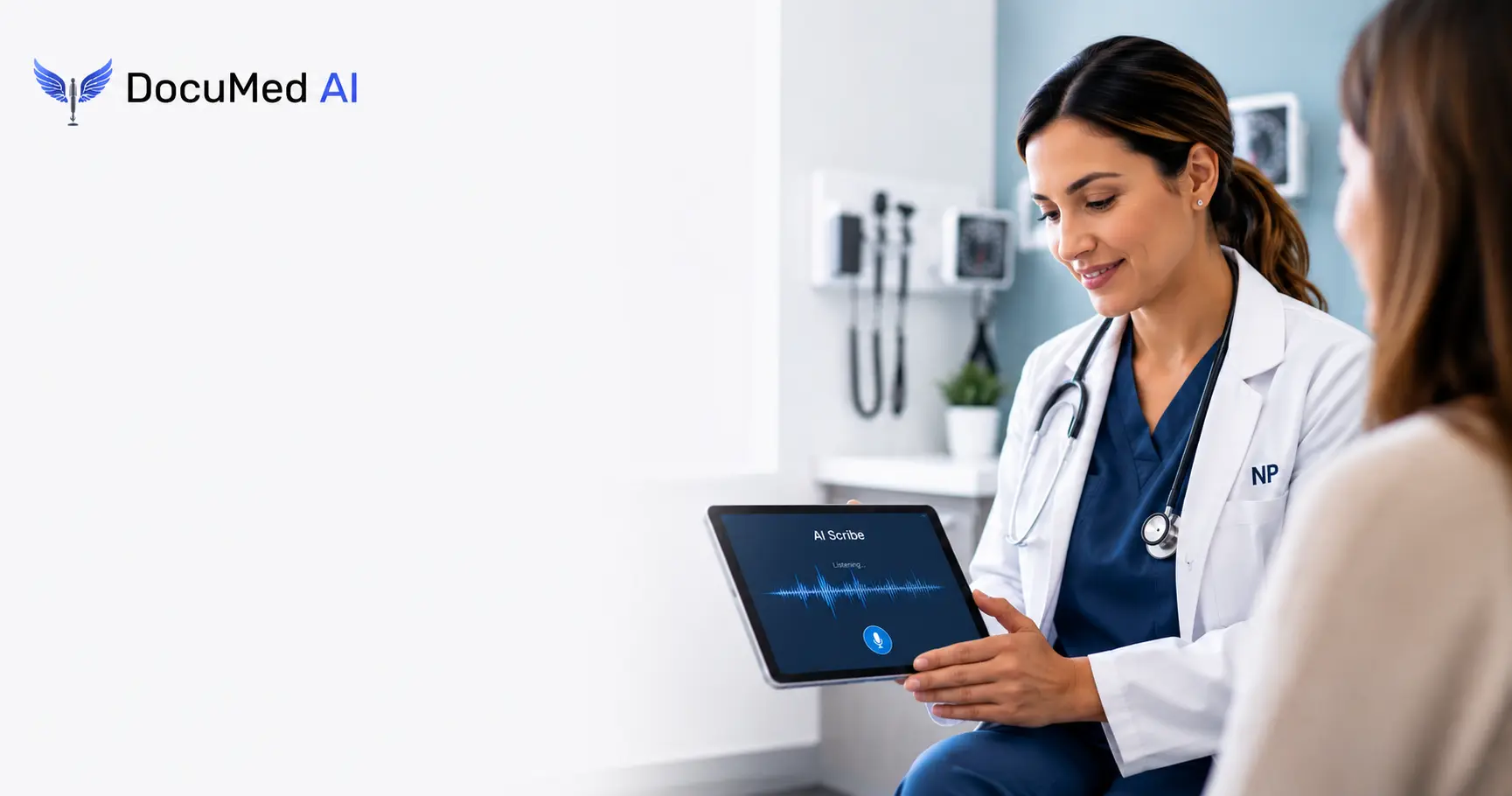
An AI medical scribe captures the patient encounter through ambient listening, then drafts a structured clinical note from the conversation. The provider reviews, edits, and signs. The workflow is the same for an NP or PA as it is for a physician.
In practice, that changes the shape of the day. Instead of reconstructing a visit from memory at the end of a session, the provider starts from a draft that already reflects what was discussed and examined. The task shifts from writing to reviewing. For a broad, high-volume advanced practice schedule, that shift is where the time comes back. Our overview of how it works walks through the capture, draft, and review steps in more detail.
Not every AI scribe fits every practice. Before committing, advanced practice providers should evaluate a few things carefully.
The draft should match how you actually document. Look for support for the note formats and specialty templates you use day to day, not a single generic structure. A tool that adapts to family medicine, urgent care, or a specialty clinic will serve a broad NP or PA scope better than a rigid template. Our guide to the best AI medical scribe features outlines what strong note quality looks like.
Any tool that handles patient conversations is handling protected health information. Confirm that the vendor offers a business associate agreement and clear data handling practices before you use it with real patients. Our guide to a HIPAA-compliant AI scribe covers what to verify, from BAA support to how audio is processed and stored.
The tool should reduce steps, not add them. Consider how it fits your electronic health record, how quickly a draft is ready, and how much editing a typical note needs. A scribe that produces a clean draft you lightly review is worth more than one that produces a rough draft you rewrite.
Advanced practice providers in solo and small practices are especially sensitive to cost and setup time. A tool that requires no training and has predictable subscription pricing lowers the barrier to trying it. Many of the same considerations that apply to a solo physician apply here, and our guide to AI tools for a solo practice is a useful companion.
The benefit is largest where documentation load is highest and support is lowest.
In each of these, the value is the same: the provider stays present with the patient during the visit and reviews a draft afterward, rather than splitting attention between the patient and the keyboard.
It is worth being clear about the boundary. An AI scribe supports documentation. It does not make clinical decisions, diagnose, or replace the provider's judgment. The NP or PA remains responsible for the accuracy of every note and for the care it records. The tool drafts; the clinician verifies and signs. Used that way, it is a documentation aid, not a decision-maker.
Yes. AI medical scribes work the same way for NPs and PAs as for physicians. The provider activates the session, the tool drafts a structured note from the encounter, and the provider reviews, edits, and signs it. The clinician remains responsible for the final note.
It can be, when the vendor meets appropriate privacy and security standards. Confirm that the tool offers a business associate agreement and clear data handling before using it with patients. Handling of audio and storage practices are worth checking specifically.
The better tools support multiple note formats and specialty templates, which suits the broad scope many NPs and PAs carry. Look for template flexibility rather than a single generic structure so the draft matches the visit type.
Often yes, because solo and small practices usually lack dedicated scribes or coders. A tool with no training requirement and predictable pricing lowers the barrier, and the time recovered from charting can be significant when the provider carries the full administrative load.
Nurse practitioners and physician assistants shoulder a large and growing share of clinical documentation, often with less support than they deserve. An AI medical scribe will not change scope or volume, but it can change how the note gets written, moving the provider from writing to reviewing and giving time back to patient care. The keys are note quality, privacy, workflow fit, and low setup friction.
If documentation is following you home, DocuMed AI drafts your notes so you can review instead of type. Book a demo to see how it fits an advanced practice workflow, or compare plans on our pricing page.
This article is for educational purposes only and is not clinical, legal, or compliance advice. Nurse practitioners and physician assistants should follow their state scope of practice, licensure requirements, and organizational policies.
Enjoy clinical practice again without the administrative burden. Start your free trial of DocuMed AI today.
SIGN UP NOWSubscribe to Our Newsletter for the Latest in Healthcare Innovation
.png)
DocuMed AI leverages advanced AI Scribe GPT technology to convert ambient sounds and physician-patient conversations into professional medical notes, seamlessly formatted for electronic medical records (EMRs).


.png)

.png)
.png)