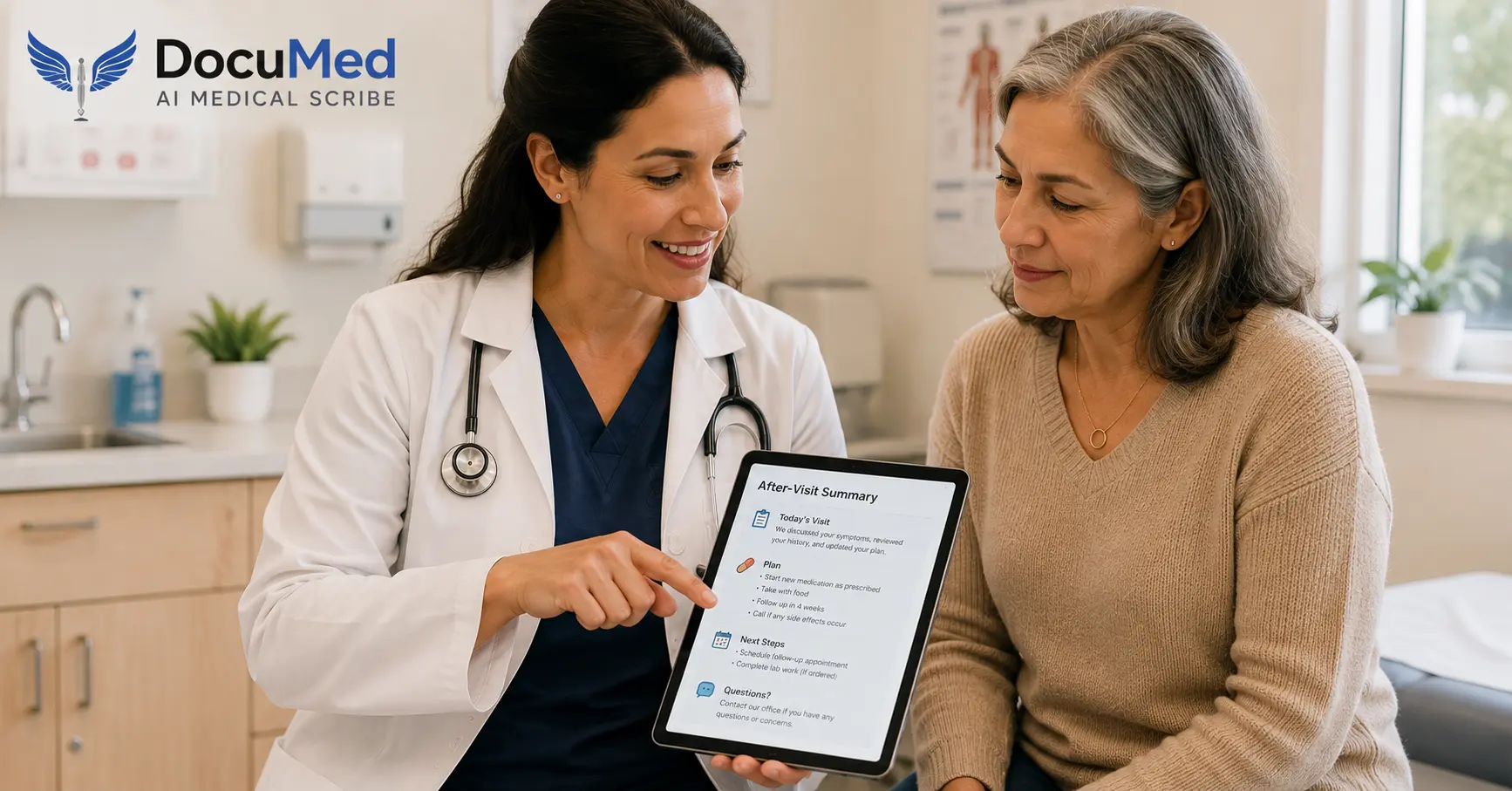
An AI-generated after-visit summary is a plain-language recap of a patient's visit, produced automatically from the clinical encounter and reviewed by the clinician before it reaches the patient. It replaces the rushed, handwritten instruction sheet with a structured document that explains what happened during the visit, what the patient needs to do next, and why it matters, written in language a patient can actually use.
An after-visit summary, or AVS, is the document a patient takes home, or reads in the patient portal, after an appointment. It typically covers the reason for the visit, a summary of what was discussed or found, any diagnoses, medication changes, follow-up instructions, and when to seek care again. An ai after-visit summary is the same document, but generated from the visit itself using ambient AI rather than typed out by hand between patients.
With DocuMed AI, the after-visit summary is one of the standard output document types the platform produces, alongside progress notes, consult notes, H&P documentation, discharge summaries, and referral letters. The clinician does not draft a separate patient handout from scratch. The AVS is generated from the same visit the clinical note comes from.
A clear after-visit summary is not paperwork. It is part of the clinical outcome. Patients forget a large share of what is said in the exam room within minutes of leaving it, and a written summary is often the only record they have of what to do next.
None of this depends on the visit being complicated. A routine follow-up still benefits from a written record of what changed and what happens next, and a straightforward summary is easier to produce consistently when it comes from the visit itself rather than from memory after the fact.
Producing a good AVS by hand takes real time, and it competes directly with the rest of a clinician's documentation load. Research on physician time allocation found that ambulatory physicians spend close to half the office day on EHR and desk work, roughly two hours of documentation for every hour spent in direct contact with patients (Sinsky CA, et al., Annals of Internal Medicine, 2016). Writing a plain-language patient summary in that same window, on top of the clinical note, coding, and everything else in the chart, is usually the first thing to get compressed into a generic template or skipped altogether.
DocuMed AI reports that clinicians using the platform cut daily documentation time by roughly half, about one to two hours a day, and save 40+ hours a month overall. An automated after-visit summary is part of that time savings: instead of writing a second, simplified version of the note after the visit, the clinician reviews a draft that is already generated.
DocuMed AI is an ambient medical scribe. It listens to the visit, or transcribes an uploaded audio file, and turns that encounter into structured clinical documentation, including a patient-facing after-visit summary, without the clinician typing a separate handout.
DocuMed AI's ambient clinical documentation also feeds an AI-chat assistant that can take a finished note and produce a different document from it. The same base note that supports a clinical letter to a colleague can also be turned into a plain-language summary for the patient, on request. That is a separate use of the same underlying note, not a direct EHR connection. For the full mechanics of the recording-to-note pipeline, see how DocuMed AI works.
A clinically accurate summary is not automatically a useful one. Medical shorthand, abbreviations, and dense clinical phrasing that make sense to a colleague can be confusing or intimidating to a patient reading the same document at home. Effective ai patient instructions translate the clinical reasoning into everyday language: what was found, what it means, what to do, and when to call.
This matters most for the sections patients act on directly: medication names, doses, and changes; follow-up timing; warning signs that mean call the office versus go to the emergency room; and any lifestyle or self-care instructions. Because DocuMed AI generates the AVS from the actual visit conversation rather than a generic template, the summary can reflect the specific plan discussed with that patient, in plain terms, rather than a boilerplate handout that says everything and nothing.
An after-visit summary always contains protected health information, so how it is handled matters as much as how it reads. DocuMed AI processes visit audio and the documents generated from it, including the AVS, under enterprise-grade encryption, and business associate agreements are available for practices that need one. That handling sits inside the same treatment context HIPAA already accounts for: the Department of Health and Human Services notes that treatment, payment, and health care operations generally do not require separate patient authorization. A patient-facing summary generated to continue that patient's care falls within that same framework.
DocuMed AI does not send an after-visit summary to a patient automatically. Every document the platform generates, including the AVS, goes through clinician review first. This is physician-in-the-loop by design, not an optional step. The clinician reads the draft, corrects anything that needs correcting, adjusts tone or emphasis, and only then does the summary go out.
That review step matters for two reasons. First, it keeps clinical judgment in charge of what a patient is told, which is where it belongs. Second, it is the point where a clinician can catch anything the AI missed or misheard, tighten language that is still too clinical, or add a note specific to that patient that would not otherwise be in the transcript. The after-visit summary generator writes the first draft. The clinician decides what actually reaches the patient.
Not every practice, specialty, or patient needs the same after-visit summary. DocuMed AI offers 100+ customizable note and document templates and custom assessment styles, and the platform adapts to a clinician's documentation style over time. A pediatric practice can build an AVS template that speaks to a parent. A cardiology or endocrinology practice can standardize follow-up and monitoring language across the whole care team. A behavioral health or substance use practice can adjust tone accordingly. Custom templates can also be shared across a team or service, so every clinician's AVS follows the same structure even though the content is different for every patient.
DocuMed AI is built for use across specialties and care settings, from solo and group practices to hospitals, multi-site networks, and telehealth. See the full range of specialties and care settings DocuMed AI supports to find a template starting point close to your own workflow.
Because DocuMed AI runs on mobile, tablet, and web, the clinician can review and edit the after-visit summary right after the visit, on whatever device is already in hand, instead of waiting until the end of the day to catch up on patient handouts.
No. DocuMed AI generates a draft after-visit summary from the visit, but a clinician always reviews and edits it before it is shared with the patient. The platform does not auto-file or auto-send patient documents.
No. DocuMed AI does not connect directly to EHR or patient portal systems. The clinician copies the finished note or summary with one click and pastes it into whatever EHR, portal, or patient communication system the practice already uses.
Yes. DocuMed AI includes 100+ customizable templates and custom assessment styles, and templates can be shared across a team so the AVS format stays consistent while the content reflects each patient's visit.
An after-visit summary is written for the patient. A clinical letter to another physician or a referral letter is written for a colleague and uses clinical language and structure appropriate for a professional audience. DocuMed AI generates both from the same visit, but they are different documents with different readers.
DocuMed AI reports 99%+ clinical accuracy in its generated documentation. Clinician review remains required for every note and summary regardless of that accuracy rate, since the clinician is the one accountable for what the patient receives.
The structured clinical note DocuMed AI produces from a recorded or uploaded visit appears within seconds, and the after-visit summary is generated from that same encounter. The time a clinician spends afterward is mostly review and light editing, not drafting from a blank page.
An after-visit summary is only useful if a patient can actually read and act on it, and it should not take longer to write than the visit itself. DocuMed AI generates a draft AVS directly from the encounter, in plain language, ready for a quick clinician review before it goes to the patient. Try DocuMed AI for free to see how it fits into your own after-visit workflow.
Enjoy clinical practice again without the administrative burden. Start your free trial of DocuMed AI today.
SIGN UP NOWSubscribe to Our Newsletter for the Latest in Healthcare Innovation
.png)
DocuMed AI leverages advanced AI Scribe GPT technology to convert ambient sounds and physician-patient conversations into professional medical notes, seamlessly formatted for electronic medical records (EMRs).


.png)

.png)
.png)