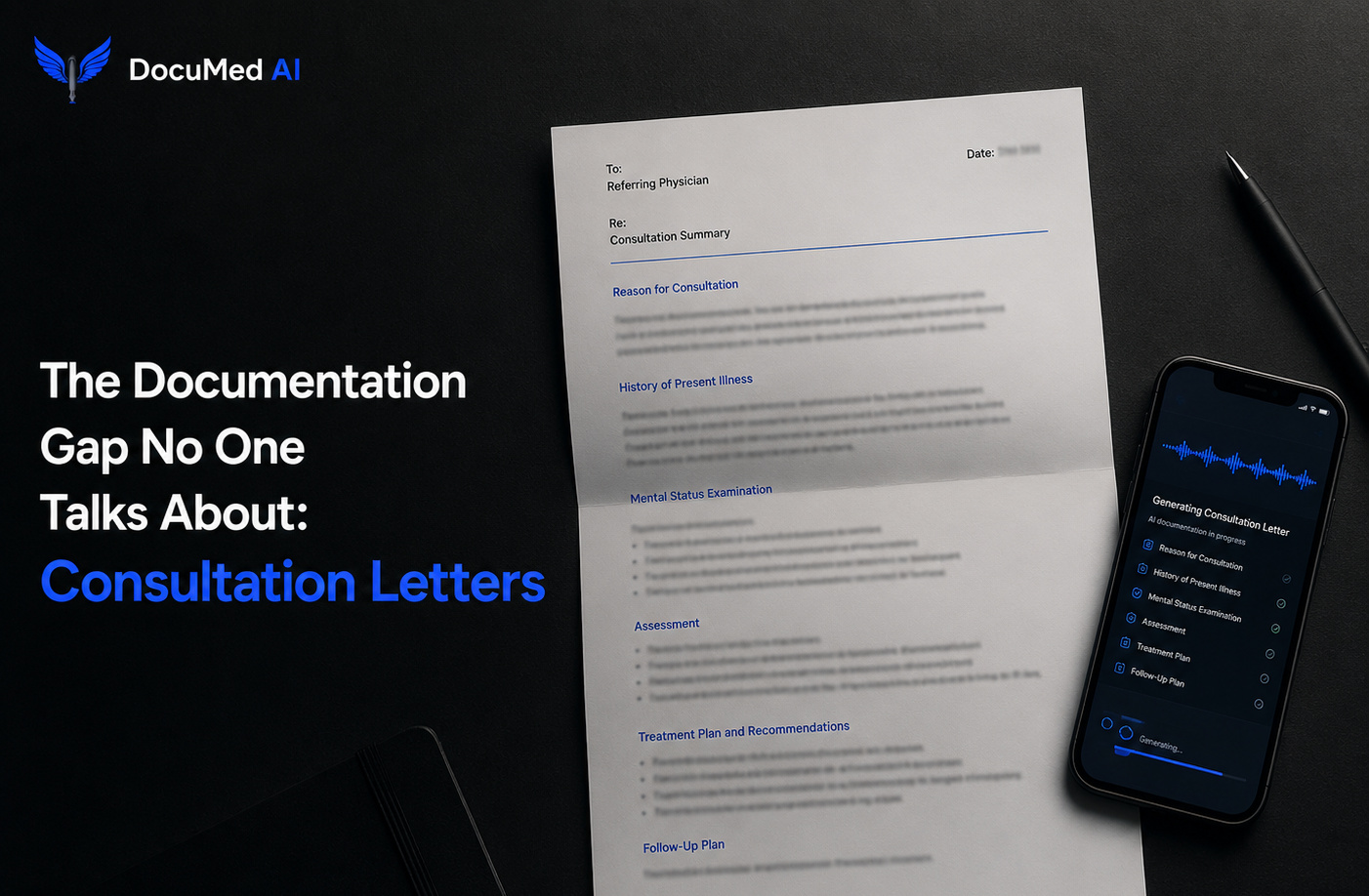
Every conversation about AI documentation in medicine gravitates toward the same document. The progress note.
That makes sense. Progress notes are high-volume, time-consuming, and immediately visible. But the document that creates the most clinical risk when it goes wrong is rarely the one getting the most attention.
The consultation letter closes the referral loop. It is the written communication that travels from the specialist back to the referring physician after a patient is seen. It confirms what was found, what was recommended, and what happens next.
When it is complete and timely, it is one of the most clinically valuable documents in a patient's care. A referral should remain open in the system until two things happen: the appointment occurs, and the specialist's consult note returns to the referring provider. Until that moment, the patient's care episode is clinically incomplete. ReferralMD
Most of the time, that moment does not come when it should.
The data on consultation letter completion is stark, and it has been for years.
A 2018 analysis of primary care referrals to specialists found that of the 103,737 referral scheduling attempts analyzed, only 36,072, or 34.8 percent, resulted in documented complete appointments defined by the specialty clinician providing a report to the referring physician after the referral visit. MDinteractive
That means roughly two thirds of referrals never close the loop. The referring physician does not receive the consultation report. The patient's primary care record stays incomplete. Clinical decisions at the next visit get made without the specialist's findings.
The average patient now waits 31 days for a specialist appointment, a 19 percent increase from 2022 and a 48 percent jump since 2004. For certain specialties the wait is far longer: OB/GYN averages 41.8 days, gastroenterology 40 days, and cardiology 33 days. ReferralMD
The appointment wait is one problem. The documentation delay after the appointment is a second, largely invisible one. A patient sees a cardiologist after a 33-day wait. The cardiologist sees eight more patients that afternoon. The consultation letter lands on the to-do list. The referring physician follows up two weeks later and discovers there is nothing in the record.
The referral letter, still the dominant format across much of primary and secondary care, is written under time pressure, drawn from memory and partial record review, and transmitted in a format that resists automated processing. Tandem Health
The consultation letter is not failing because physicians do not understand its importance. It is failing because it sits at the end of a demanding clinical day with no structural support.
A specialist who has seen 12 patients in a session carries 12 pending consultation letters into the afternoon, each requiring a different level of clinical detail, a different recipient, and a different framing of findings. Written manually, each letter takes 15 to 20 minutes to produce. That is two to four hours of correspondence work that sits on top of a full clinical day.
The letter that gets written well is the one from the morning, when recall is sharpest and time pressure is lowest. By the fifth patient of the afternoon, the letter is shorter, the clinical reasoning is compressed, and the referring physician receives something that tells them less than the case required.
Clinical referrals represent one of the most consequential handovers in medicine. Responsibility for a patient's care transfers from one clinician to another, often across entirely separate organisations and systems. Yet the information accompanying that handover frequently falls short of what the receiving specialist needs to act. Tandem Health
Incomplete consultation letters have measurable downstream effects. Research into pediatric rheumatology referrals found that further information was requested for 15 percent of referrals, resulting in a median delay in time-to-triage of seven additional days. That delay is caused not by clinical complexity but by missing information in the documentation. The same pattern repeats across specialties.
Part of why consultation letters are routinely incomplete is that the standard for completeness is genuinely demanding.
A consultation letter that does its job communicates all of the following to the referring physician:
The clinical question being answered. The specialist should confirm they understood why the patient was referred and address that question directly.
Examination findings. Not a generic summary. The specific findings relevant to the referral indication, documented with enough precision for the referring physician to track change over time.
Diagnostic results. Any investigations ordered or reviewed during the consultation, with their clinical interpretation.
Diagnosis and differential. The specialist's working diagnosis, including any alternative explanations being considered and the reasoning applied.
Management plan. What the specialist recommends and who is responsible for executing each element.
Follow-up arrangement. Whether the patient is being retained in specialist care, returned to the referring physician, or managed jointly, and on what timeline.
Writing all of that from scratch after a full clinic day, at the precision level the referral process requires, is where the letters go short. The clinical knowledge is there. The time and structural support to express it fully are not.
AI clinical letter automation does not ask the specialist to find more time. It eliminates the writing task from within the time that already exists.
When an AI documentation platform captures a consultation encounter, the same session that generates a clinical note can simultaneously produce a structured consultation letter addressed to the referring physician. The specialist reviews the draft, confirms accuracy, and approves. The referring physician receives a complete letter, generated from the actual clinical encounter, not reconstructed from memory 48 hours later.
The medical industry spends billions annually on manual administrative tasks that automated systems could handle. Payer scrutiny regarding documentation timeliness has reached a peak in 2026, with many insurance contracts now including strict clauses that allow for reduced reimbursement or outright denials if documentation is not finalized within 48 to 72 hours. Your Health Magazine
The automation advantage compounds across the practice. A specialist who previously produced 8 consultation letters per week manually, spending two to three hours, can review the same volume in under 30 minutes when AI generates the draft from the session. That time goes back to patient care, not administrative catch-up.
DocuMed AI generates consultation letters as part of its full documentation stack. The same encounter that produces the progress note can generate the consultation letter, the referral letter, and the after-visit summary, all structured for different recipients from a single clinical session.
The consultation letter is not just an administrative document. It is a clinical risk management tool.
Breakdowns in referral communication lead to worse health outcomes, increased cost, and appointment delays. The referral loop measure is now included as a formal care coordination metric under CMS quality reporting, and under value-based arrangements, incomplete referrals create gaps that show up in quality scores and total cost of care. MDinteractive
For cardiology specifically, the clinical stakes are direct. Research examining delayed cardiology consultation after primary care referrals in heart failure patients found a measurable association between elapsed time to specialist care and one-year outcomes, including all-cause mortality, cardiovascular mortality, and heart failure mortality. This gap in understanding the impact of delayed cardiology consultation post-referral on one-year outcomes reflects how consequential these documentation failures can become when they delay care access. Wiley Online Library
A consultation letter that arrives late or arrives incomplete is not a minor inconvenience. It is a clinical handover failure. The primary care physician sees the patient at their next appointment without the information needed to manage them optimally. Medications get continued that the specialist would have changed. Follow-up investigations do not get ordered. The specialist's findings stay locked in a letter no one has read yet.
Consultation letter failure is harder to see than other documentation problems because the consequences are diffuse. A delayed progress note affects one encounter. A delayed or incomplete consultation letter affects a care relationship between two physicians, a patient in the middle, and clinical decisions made without complete information across weeks or months.
No one physician owns the failure when it happens. The specialist is managing volume. The referring physician assumes the letter is coming. The patient assumes their doctors are communicating.
The gap stays hidden until something goes wrong and someone asks when the consultation note was received.
AI clinical letter automation addresses this proactively. When the documentation is generated at the time of the encounter rather than deferred to end-of-day reconstruction, the letter exists before the clinical detail fades. The referring physician receives what the specialist actually found, documented at the precision level the encounter supported, not the abbreviated version the schedule allowed.
DocuMed AI generates consultation letters alongside progress notes, referral letters, after-visit summaries, and prior authorization documentation from a single clinical encounter. The template library includes specialty-specific consultation letter formats structured for the receiving provider, with the clinical depth that makes specialist correspondence clinically useful rather than perfunctory.
The platform is HIPAA-compliant from session capture through document export. No training is required to get started, and the free trial gives access to the full template library from the first session.
The documentation gap in consultation letters is not a new problem. The tools to close it exist now.
Enjoy clinical practice again without the administrative burden. Start your free trial of DocuMed AI today.
SIGN UP NOWSubscribe to Our Newsletter for the Latest in Healthcare Innovation
.png)
DocuMed AI leverages advanced AI Scribe GPT technology to convert ambient sounds and physician-patient conversations into professional medical notes, seamlessly formatted for electronic medical records (EMRs).


.png)

.png)
.png)