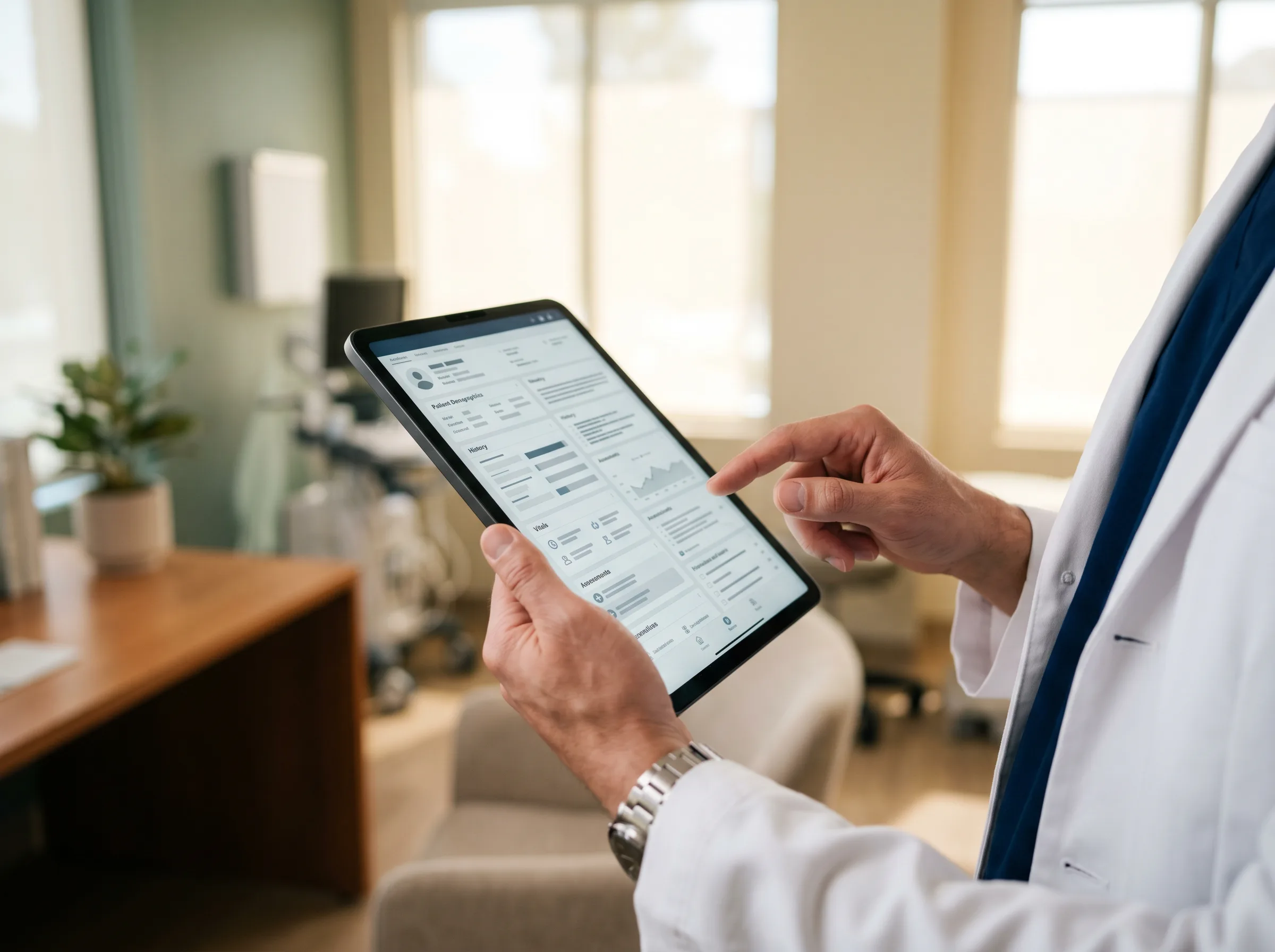
A SOAP note template helps clinicians document patient visits in a clear, organized, and repeatable way.
Instead of starting from a blank page, the template gives you a simple structure:
This makes clinical documentation easier to write, easier to review, and easier for the care team to follow.
This guide gives you a practical SOAP note template, explains what to include in each section, and shows how to adapt the format for different clinical settings.
A SOAP note template is a structured clinical documentation format used to organize patient encounter notes.
SOAP stands for:
Each section has a clear role:
The template helps clinicians write notes that are clear, consistent, and easier to scan.
A SOAP note template helps reduce documentation friction.
Without a structure, notes can become inconsistent, too long, too vague, or difficult to review. A template gives every visit a predictable format.
A good SOAP note template can help with:
The goal is not to make every note identical. The goal is to make every note easier to understand.
Use this template as a starting point and adapt it to your specialty, visit type, and workflow.
Use this section for information reported by the patient, caregiver, or family member.
Include:
Use this section for observable, measurable, or verified information.
Include:
Use this section to explain the clinician’s impression and reasoning.
Include:
Use this section to document the next steps.
Include:
The Subjective section should capture the patient’s story.
This section may include symptoms, concerns, history, medication changes, allergies, and patient goals.
Helpful prompts include:
Keep this section focused. It should include relevant patient-reported information, not every detail from the conversation.
The Objective section should include findings that can be observed, measured, tested, or verified.
Examples include:
Avoid putting patient-reported symptoms here.
For example:
The Assessment section explains what the information means.
This section may include the diagnosis, differential diagnosis, clinical impression, and reasoning.
A weak assessment might say:
Cough.
A stronger assessment might say:
Acute cough, likely viral upper respiratory infection based on short duration, mild fever, clear lung exam, and normal oxygen saturation.
The Assessment should show the connection between the patient’s story, the objective findings, and the clinician’s impression.
The Plan section explains the next steps.
A good Plan should be specific and actionable.
It may include:
A vague Plan is hard to follow.
Instead of:
Follow up if needed.
Write something more useful:
Follow up in one week if symptoms are not improving. Return sooner if shortness of breath, chest pain, persistent fever, or worsening symptoms occur.
Fictional example only. This is not a real patient and contains no real protected health information. It is for educational purposes only and should not be used as medical advice.
Patient reports:
Clinician notes:
Acute cough and sore throat, most consistent with viral upper respiratory infection. Bacterial pharyngitis is less likely based on lack of tonsillar exudate and lack of significant lymph node findings. Pneumonia is less likely given normal oxygen saturation and clear lung exam.
Fictional example only. This is not a real patient and contains no real protected health information. It is for educational purposes only and should not be used as medical advice.
Client reports:
Clinician notes:
Client presents with increased stress and sleep difficulty related to work demands. Symptoms appear to affect sleep and concentration. Client demonstrates insight and willingness to practice coping strategies. Continued monitoring of mood, anxiety symptoms, sleep patterns, and safety is appropriate.
Follow-up notes are often shorter than initial visit notes, but they still need a clear structure.
Include:
Include:
Include:
Include:
Telehealth visits may limit what can be measured or observed, so the note should make the setting clear.
Include:
Include:
Include:
Include:
A template should help the clinician write faster, not slow them down.
Avoid adding too many fields that are rarely used. Keep the structure useful and practical.
Different specialties need different details. A behavioral health SOAP note is not the same as a primary care SOAP note. A physical therapy note is not the same as a medication follow-up.
Customize the template for the setting.
Keep patient-reported information in Subjective and clinician-observed information in Objective.
This keeps the note easier to understand.
The Plan should explain what happens next.
Avoid vague phrases like:
Instead, be specific about timing, actions, education, and return precautions.
The Assessment should not only list a diagnosis. It should explain why the clinician thinks that diagnosis or impression fits the visit.
Before signing a SOAP note, check:
Yes. AI can help clinicians draft SOAP notes faster by turning the visit conversation into a structured note.
An AI SOAP note generator or AI medical scribe can help with:
However, AI-generated notes still require clinician review. The clinician remains responsible for the final documentation.
AI should support clinical documentation, not replace medical judgment.
Before using AI for SOAP notes, ask:
A good AI workflow should make SOAP note drafting easier while keeping the clinician in control.
A SOAP note template is a structured format used to document patient encounters using Subjective, Objective, Assessment, and Plan sections.
A SOAP note template should include patient information, chief complaint, history, objective findings, assessment, clinical reasoning, plan, follow-up, and patient education when relevant.
No. The basic structure is the same, but the details should change by specialty, setting, and visit type.
Yes, but the template should note the telehealth setting and any limitations of the remote exam.
A SOAP note is a type of progress note with a specific structure: Subjective, Objective, Assessment, and Plan.
AI can help draft SOAP notes from a clinical conversation, but the clinician should always review, edit, and approve the final note.
Yes. SOAP notes can be used in behavioral health, although some clinicians may prefer formats like DAP or BIRP.
A SOAP note should be long enough to clearly document the encounter, but not longer than needed. The best notes are clear, specific, and easy to follow.
A SOAP note template helps clinicians document visits in a consistent, organized, and practical way.
The best templates are simple enough to use every day and flexible enough to adapt to different specialties.
Whether you are documenting a primary care visit, a behavioral health session, a follow-up, or a telehealth visit, the goal is the same: create a note that clearly explains the patient’s story, the clinical findings, the assessment, and the plan.
If documentation is taking too much time, DocuMed AI can help clinicians draft structured SOAP notes faster while keeping the clinician in control. See how DocuMed AI works or book a demo to learn how AI can support your documentation workflow.
For more updates on AI medical scribes, SOAP notes, clinical documentation, and healthcare workflow automation, follow DocuMed AI on LinkedIn, Facebook, Instagram, and YouTube.
Stay connected for practical tips, product updates, and simple guides that help healthcare teams reduce documentation time and improve their clinical workflow.
Enjoy clinical practice again without the administrative burden. Start your free trial of DocuMed AI today.
SIGN UP NOWSubscribe to Our Newsletter for the Latest in Healthcare Innovation
.png)
DocuMed AI leverages advanced AI Scribe GPT technology to convert ambient sounds and physician-patient conversations into professional medical notes, seamlessly formatted for electronic medical records (EMRs).


.png)

.png)
.png)