Running an independent practice in 2026 means carrying burdens that employed physicians hand off to a department. There is no IT team to evaluate software. No enterprise contract to leverage. No clinical informatics team to manage implementation. When something does not work, it lands on the physician or, more often, on whatever staff is available.
That context matters when evaluating AI documentation tools. The criteria for a solo or small-group practice are different from those driving enterprise health system purchasing decisions. What works at Mass General Brigham does not automatically translate to a two-physician family medicine office or a solo psychiatrist running a cash-pay practice.
This guide is written specifically for independent physicians evaluating AI for private practice documentation, with practical criteria and no enterprise assumptions.
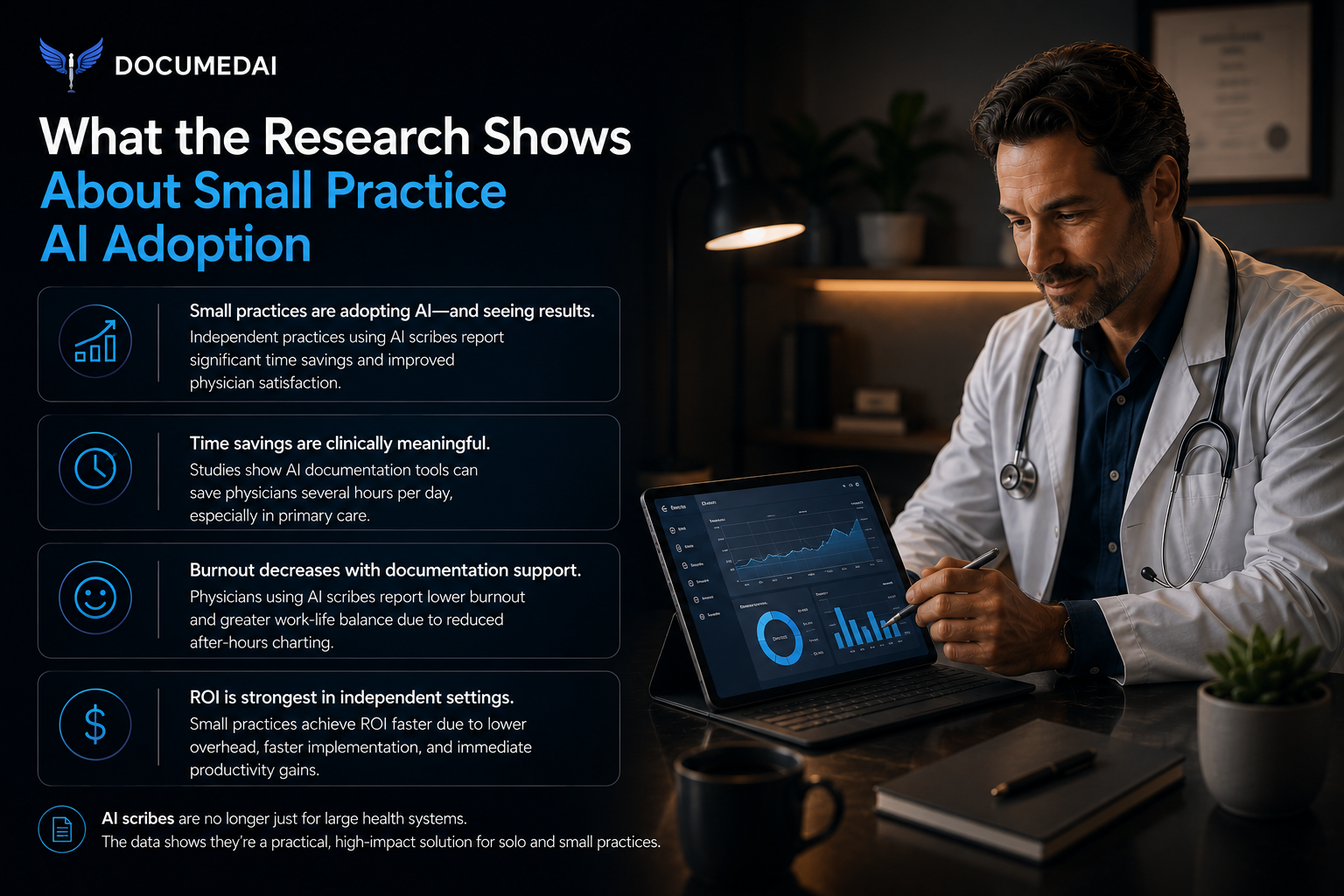
The return on AI documentation investment is proportionally larger in independent practice than in any other setting.
In a health system, a physician who saves an hour of documentation per day contributes to aggregate efficiency metrics. In a solo practice, that same hour saved is an hour the physician can use to see an additional patient, leave on time, or avoid the documentation debt that accumulates into weekend charting.
AI use in ambulatory practices is becoming common, and the payoff is largest in administrative work, where some practices are seeing major overhead savings.
Solo and very small practices often struggle with AI integration due to lack of IT staff to vet tools, and the relative cost per provider is higher than in large group settings. That gap has narrowed considerably. The current generation of AI scribe tools was largely designed with independent practice adoption in mind, requiring no IT infrastructure, no EHR-side implementation, and minimal onboarding time. Themdpreferrednetwork
A 2025 survey found physicians received an average of 77 EHR inbox messages per day, largely uncompensated. For those running lean operations without institutional backup, there is no buffer when administrative load spikes. Healthcare Dive
AI documentation tools do not solve the inbox problem entirely. But they reclaim enough time within the clinical day that physicians have capacity to address it.
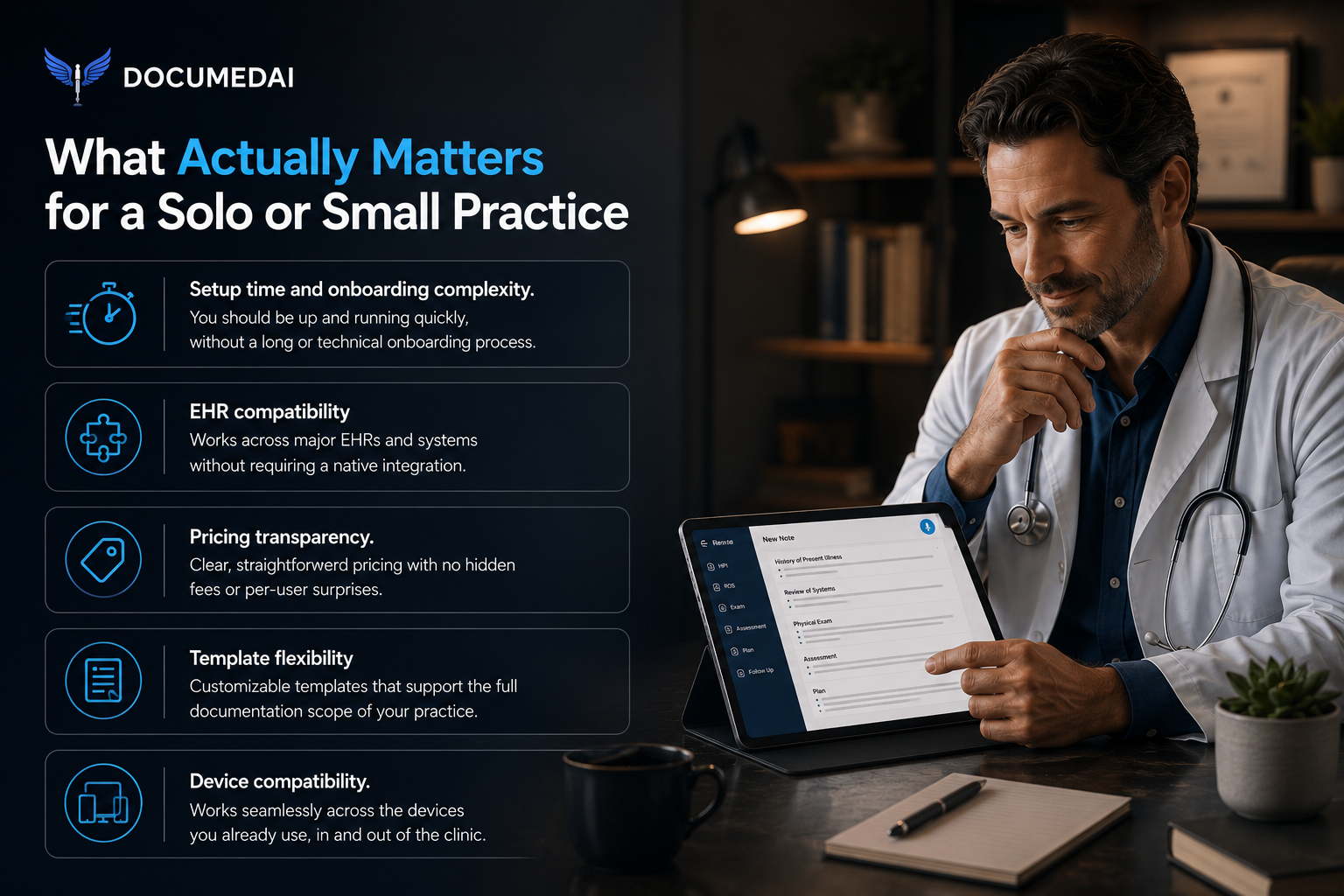
Evaluating small clinic AI tools involves a different set of priorities than enterprise procurement. Here is what independent physicians should focus on:
Setup time and onboarding complexity. A tool that requires weeks of configuration or IT involvement is not viable for a solo practice. The right platform should be functional from day one, with note quality good enough to use within the first few sessions. DocuMed AI requires no training to start.
EHR compatibility without a native integration requirement. Most independent practices do not use Epic. They use athenahealth, eClinicalWorks, Practice Fusion, DrChrono, or dozens of other systems. A copy-paste workflow that works with any EHR is the baseline requirement. Native write-back is a bonus, not a necessity.
Pricing transparency. Per-provider monthly subscriptions are now the standard model. Solo practitioners should be able to access a free trial without committing to an annual contract, and the pricing should be public or available on request without a sales conversation.
Template flexibility for the full documentation scope. A solo practice physician does not just write progress notes. They write referral letters, prior authorization documentation, letters to attorneys, school and work excuse documentation, discharge instructions, and specialist correspondence. The AI tool needs to cover this full scope.
Device compatibility. Independent physicians often move between a desktop workstation, a laptop for telehealth, and a mobile device for hospital rounding or home visits. The tool needs to work across all three without a separate license per device.
As of early 2026, budget-friendly AI scribe tools can start as low as $40 per clinician per month, though these often come with strict caps on monthly notes and limited EHR integration. OmniMD
The market has stratified into clear tiers:
For solo and small practices, the mid tier typically delivers the best balance of capability and cost. DocuMed AI sits in this range and is built specifically for clinical depth and specialty breadth, not institutional scale.
The financial case is straightforward. Physicians using AI scribes generated 1.81 additional relative value units and saw roughly one more patient per week, with no increase in claim denials, translating to approximately $3,044 in additional annual revenue per physician. At a mid-tier pricing point, the tool pays for itself within weeks. OmniMD
Choosing based on the free tier, then being surprised by the upgrade. Many platforms use free tiers with strict note volume caps to drive upgrades. Evaluate the paid plan, not the free one, and confirm what happens when you exceed your monthly cap.
Assuming the tool handles specialty documentation by default. A general-purpose AI scribe may produce adequate primary care notes but struggle with the structured complexity of a cardiology consultation or a detailed psychiatric evaluation. Test the tool with your actual note types before committing.
Overlooking the review workflow. The best AI documentation outcome is a note that takes 30 seconds to review and sign, not one that requires substantial editing. Note quality, not just generation speed, is the metric that matters for daily use.
Ignoring the template library. If your practice produces referral letters, prior auth documentation, or specialist correspondence, confirm that the AI tool supports these before you see patients with it.
Projections show that by 2026 to 2027, almost all scheduling, reminders, and paperwork generation could be handled by AI tools in forward-looking practices, freeing clinicians for higher-value patient work. Themdpreferrednetwork
The practices that are ahead of that curve share a common pattern: they started with documentation, where the time return is immediate and measurable, before expanding to other AI-assisted workflows.
Voice-based documentation tools, including ambient scribes, rose to 29% of physicians by early 2026, up from 20% the prior year, with growth distributed across all practice sizes and specialties. Barton Associates
Independent practice physicians who have adopted AI documentation consistently report the same thing: the first week feels like a trial. By week three, going back feels impossible.
DocuMed AI is available on a free trial with no training required and no IT infrastructure needed. It works across all specialties, supports a full template library beyond progress notes, and was built by practicing physicians who understood that independent practice has constraints that enterprise tools are not designed for.
Start a session. See the note it produces. Decide from there.
Enjoy clinical practice again without the administrative burden. Start your free trial of DocuMed AI today.
SIGN UP NOWSubscribe to Our Newsletter for the Latest in Healthcare Innovation
.png)
DocuMed AI leverages advanced AI Scribe GPT technology to convert ambient sounds and physician-patient conversations into professional medical notes, seamlessly formatted for electronic medical records (EMRs).


.png)

.png)
.png)