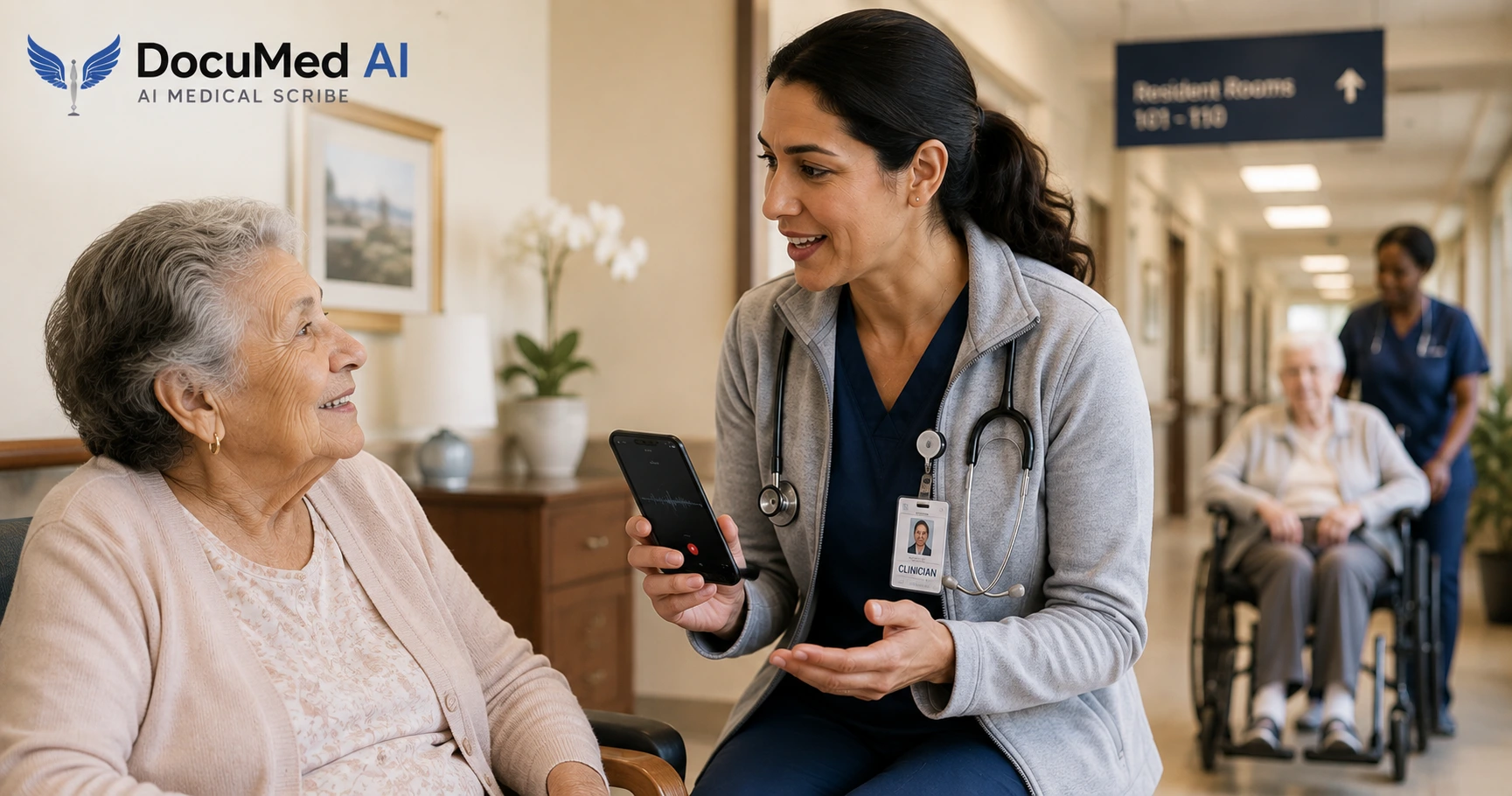
An AI medical scribe for long-term care and skilled nursing facilities listens to a resident visit, or transcribes an audio file you upload, and drafts a structured clinical note in seconds. The clinician reviews the note, edits it, and then copies it into the resident's chart. For a physician or advanced practice provider rounding through a facility with a dozen or more residents on the schedule, that shift, from typing or copy-forwarding each note to reviewing an already-drafted one, is where most of the time savings come from.
Long-term care (LTC) and skilled nursing facility (SNF) documentation has its own rhythm: high resident volume per rounding session, frequent recurring progress notes, ongoing care-plan updates, and coordination across nursing, therapy, dietary, and social work, all layered under real regulatory and compliance scrutiny. This article covers what makes LTC and SNF charting so demanding, how an ambient AI scribe fits into a rounding workflow, and where clinician review and coding support fit in.
Rounding in a skilled nursing facility is rarely a one-patient-at-a-time exercise. A single session can mean moving through a wing or an entire building, seeing a long list of residents back to back, each of whom needs a note that reflects that specific visit, not a template stamped from the last one.
Long-term care adds another layer that outpatient documentation does not: residents are often followed for months or years, not a single episode of care. That makes continuity in the chart matter more, not less. A note that is vague or recycled does not just slow down the next reader, it can obscure a real trend in a resident's condition that only shows up when notes are specific enough to compare visit to visit.
Under that kind of time pressure, the shortcut most clinicians reach for is copying yesterday's note forward and editing a line or two. It is fast in the moment, but it is also the single biggest driver of note bloat: notes grow longer and more repetitive over time, outdated details persist, and it becomes harder for anyone reading the chart, including surveyors, to tell what actually happened at this visit versus what was carried over. National research backs up how much of a clinician's day documentation already consumes: Sinsky et al. found that physicians spend roughly 49 percent of their office day on EHR and desk work, compared to about 27 percent on direct patient care, close to two hours of documentation for every hour spent with patients (Sinsky CA, et al., Annals of Internal Medicine, 2016). Rounding-heavy settings like LTC and SNF add resident volume and coordination overhead on top of that baseline.
An ambient AI scribe is built to sit inside the way LTC and SNF clinicians already work: moving room to room, seeing residents in quick succession, and needing a note that is ready to review by the time they leave the building.
The workflow itself is straightforward: record or upload audio, the visit is transcribed and processed securely, a structured note appears within seconds, the clinician reviews and edits it, and then copies the finished note into the resident's EHR with one click. DocuMed AI does not connect directly to any EHR system. It is a copy-and-paste tool that works alongside whatever chart system a facility already uses.
Because each note is generated from the actual visit rather than an old one edited in place, there is less material to copy forward and less reason to reach for it. That directly addresses the pattern we cover in more depth in our post on note bloat: notes that balloon in length and redundancy over time, making the chart harder to trust and slower to read.
The other half of the problem is timing. Rounding through a facility often runs late into the afternoon or evening, and documentation gets pushed to whatever time is left, frequently after hours at home. DocuMed AI reports that clinicians using ambient documentation cut daily charting time by roughly half, about one to two hours a day, adding up to more than 40 hours saved per month. For a clinician covering multiple LTC or SNF stops in a day, that is the difference between finishing notes before leaving the building and carrying a stack of charting home. We go deeper on this specific pattern in our piece on ending late-night charting and documentation fatigue.
None of this changes who is responsible for the note. Every note DocuMed AI generates is a draft until the clinician reviews it, edits it, and customizes it to reflect their own judgment. The tool does not auto-file notes and it does not remove the need for clinician review. That matters even more in LTC and SNF settings, since a single note can inform care-plan updates that nursing, therapy, and other team members act on directly. The full sequence, record, secure transcription, note generation, clinician review, and copy into the EHR, is laid out in detail on our How It Works page. DocuMed AI is built for the range of roles and settings involved in resident care, including physicians, nurse practitioners, and physician assistants working across long-term care, nursing homes, and skilled nursing facilities; see the full list on our Who We Serve page.
Rounding visits still need to be coded accurately, and that task competes for the same limited time as the note itself. DocuMed AI includes automated coding suggestions for E/M level, CPT, and ICD-10 codes based on the documented visit, giving clinicians a starting point rather than a blank page when it comes time to code. As with the note itself, the clinician confirms the final coding before it goes anywhere; DocuMed AI does not submit codes or claims on its own, and it does not complete regulatory assessment forms. It supports the progress note and coding step of the workflow, not the survey or reimbursement paperwork layered on top of it. For practice owners and operations leaders weighing the cost, DocuMed AI's stated return on investment is straightforward: most clinicians recoup the cost of a paid plan, or more, by conducting just one additional session a month with the time they get back.
Yes. The mobile app is built for exactly that pattern: record or upload audio for one resident, get a note back in seconds, and move to the next room. Because each note is generated fresh from that visit, clinicians are not stuck editing a long-running template as the day goes on.
No. DocuMed AI does not connect directly to any EHR or EMR system. Clinicians review the finished note and copy it with one click into whatever chart system the facility uses.
No. DocuMed AI generates progress notes and other clinical documents from the visit and offers coding suggestions. It does not automate MDS, PDPM, or other regulatory forms. Those remain a manual process handled outside the tool.
Yes. Audio is encrypted, DocuMed AI is built for HIPAA-compliant use, and Business Associate Agreements (BAAs) are available.
The clinician who conducted the visit always reviews, edits, and finalizes the note before it is copied into the chart. DocuMed AI drafts the note; it does not finalize or file it on its own.
If daily charting is eating into time you would rather spend with residents, or notes are piling up until after hours, the fastest way to know if this fits your rounding workflow is to try it against a real visit. Request a demo to walk through the workflow with your team, or sign up for free and record your next round.
Enjoy clinical practice again without the administrative burden. Start your free trial of DocuMed AI today.
SIGN UP NOWSubscribe to Our Newsletter for the Latest in Healthcare Innovation
.png)
DocuMed AI leverages advanced AI Scribe GPT technology to convert ambient sounds and physician-patient conversations into professional medical notes, seamlessly formatted for electronic medical records (EMRs).


.png)

.png)
.png)