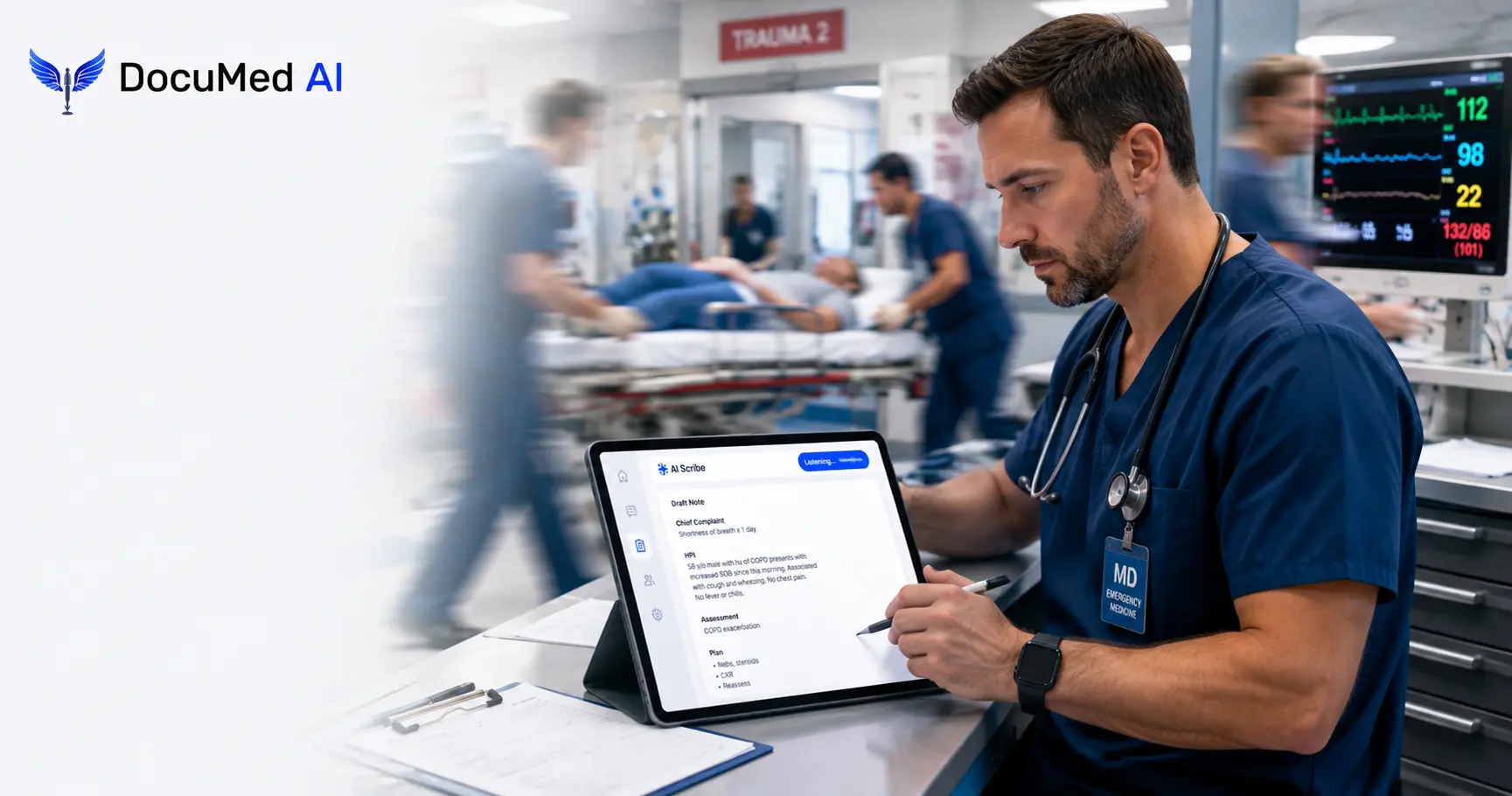
Few settings put more pressure on documentation than emergency and urgent care. The pace is fast, the case mix is unpredictable, and the note has to be complete enough to support a safe handoff, an accurate bill, and a defensible record, all while the next patient is already waiting. For clinicians in these settings, documentation is not a quiet end-of-day task. It competes for attention in real time.
This guide looks at how AI medical scribes fit emergency and urgent care documentation, what makes these settings different, and what to check before adopting a tool. It is written for emergency physicians, urgent care clinicians, advanced practice providers, and the teams that support them. It is educational and does not replace clinical judgment or your organization's protocols.
Documentation in an emergency department or urgent care clinic carries pressures that most outpatient settings do not.
All of this has to happen fast. The tension between speed and completeness is the defining documentation challenge of emergency and urgent care.
An AI medical scribe captures the encounter through ambient listening and drafts a structured note, which the clinician reviews and signs. In a fast-paced setting, the value is specific: the draft exists without the clinician stopping to type, so the record keeps up with the pace of care rather than lagging behind it.
That changes the end of each encounter. Instead of reconstructing a busy, interrupted visit from memory, the clinician reviews a draft that already reflects the conversation and the workup discussed aloud. The task shifts from writing under time pressure to reviewing for accuracy. Our overview of how it works describes the capture, draft, and review cycle, and it applies the same way whether the visit is a scheduled follow-up or an acute presentation.
Emergency and urgent care settings are demanding, so the evaluation should be rigorous.
The tool should support the wide range of presentations these settings see, from minor complaints to complex workups, and should capture the clinical reasoning that emergency documentation requires. A rigid, single-template tool will struggle with the variety. Our guide to the best AI medical scribe features describes the flexibility to look for, and specialty-oriented documentation is covered in our look at AI scribes across primary care, cardiology, and neurology.
Emergency settings are loud and chaotic. Consider how the tool performs when the conversation is interrupted or the environment is noisy, and how easily a clinician can pause and resume. A tool that assumes a quiet, uninterrupted visit will not fit the reality of the department.
These settings handle sensitive information at high volume. Confirm the tool offers a business associate agreement and clear data handling before using it with patients. Our guide to a HIPAA-compliant AI scribe covers what to verify.
In a setting defined by pace, how quickly a clean draft is ready matters more than almost anywhere else. The tool should keep up with a rapid patient flow, not slow it down.
In emergency and urgent care, documentation that falls behind is not just an administrative nuisance. It has clinical and operational consequences that compound over a shift.
An AI scribe addresses the lag directly by producing the draft close to the encounter, while recall is sharp and before the note has a chance to pile up. That does not remove the clinician's review, but it keeps the record moving at the pace of the department.
An AI scribe documents; it does not decide. In emergency and urgent care, where decisions carry high stakes and the record is closely examined, the clinician's review is not optional. The tool drafts the note from the encounter, and the clinician confirms that it accurately reflects the workup, the reasoning, and the disposition before signing. For particularly complex or high-acuity cases, that review is where the clinician makes sure nothing important was missed or misstated.
The boundary is the same as in any setting, but the stakes make it sharper. AI reduces the burden of producing the note. It does not reduce the clinician's responsibility for its accuracy or for the care it records.
A well-designed AI scribe drafts a note from the encounter without the clinician stopping to type, which helps documentation keep pace with a fast setting. The clinician still reviews and signs each note, and how quickly a usable draft is ready is an important thing to evaluate.
Performance in noisy, interrupted environments varies by tool, so it is worth checking specifically. Consider how the tool handles interruptions and how easily a clinician can pause and resume capture during a chaotic visit.
An AI scribe supports documentation but does not make clinical decisions. For high-acuity cases, the clinician's review is essential to confirm the note accurately reflects the workup and reasoning. The clinician remains responsible for the record.
Look for breadth to handle varied presentations, reliable performance in a busy environment, fast turnaround to a usable draft, and appropriate privacy protections including a business associate agreement. Workflow fit with the clinic's pace matters most.
Emergency and urgent care documentation lives at the intersection of speed and completeness, and that is exactly where the burden is heaviest. An AI medical scribe can help by drafting the note from the encounter so the record keeps pace with care, letting the clinician review rather than write under pressure. The essentials to evaluate are breadth, performance in a demanding environment, speed, and privacy, with the clinician's review remaining central for high-stakes cases.
If documentation is competing with patient care in your department, DocuMed AI drafts the note so you can review instead of type. Book a demo, or see how it adapts across practice settings.
This article is for educational purposes only and is not clinical, legal, or compliance advice. Clinicians remain responsible for their documentation and for all clinical decisions, and should follow their department's protocols.
Enjoy clinical practice again without the administrative burden. Start your free trial of DocuMed AI today.
SIGN UP NOWSubscribe to Our Newsletter for the Latest in Healthcare Innovation
.png)
DocuMed AI leverages advanced AI Scribe GPT technology to convert ambient sounds and physician-patient conversations into professional medical notes, seamlessly formatted for electronic medical records (EMRs).


.png)

.png)
.png)