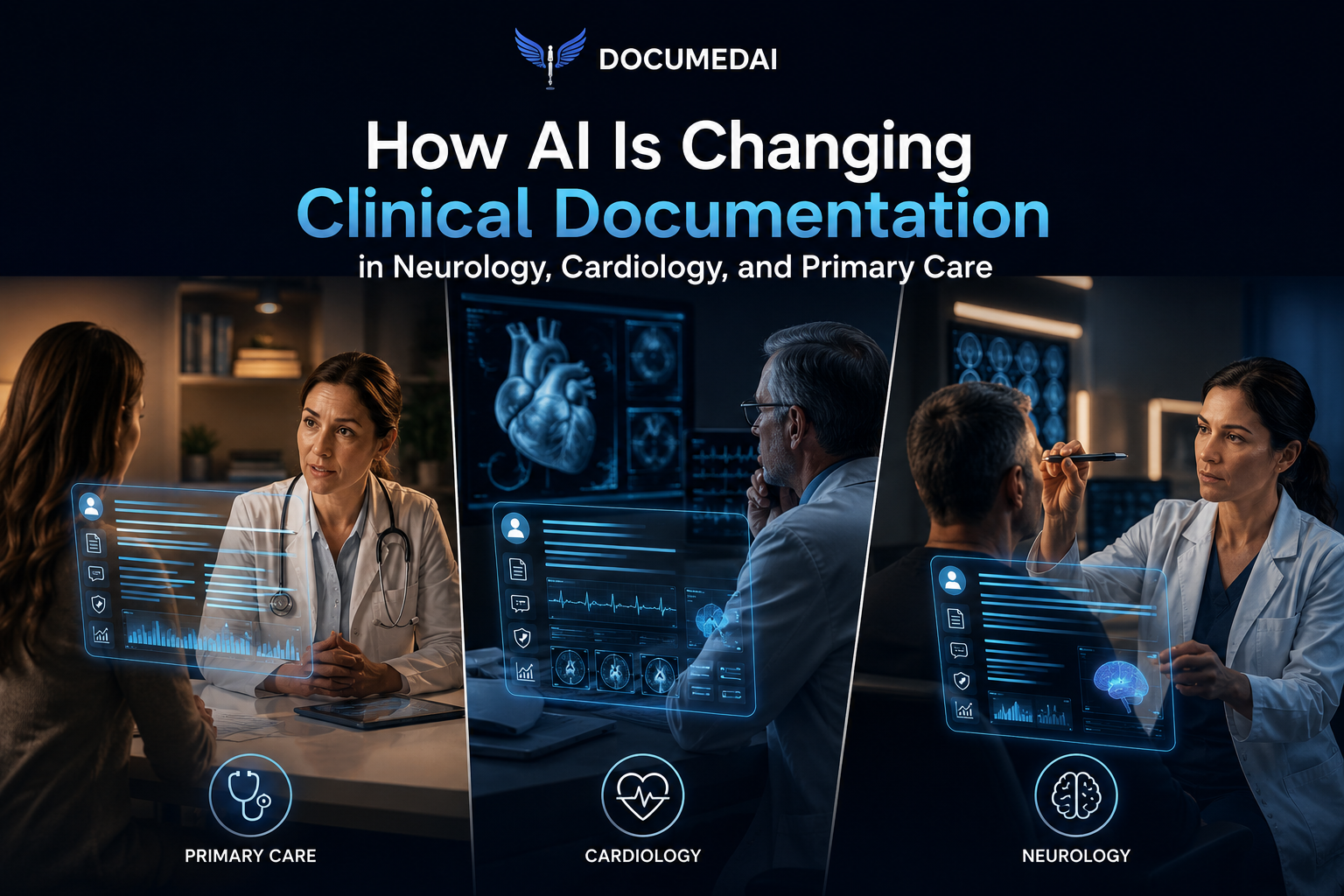
Not all clinical documentation is created equal. A primary care physician documenting a well visit and a neurologist documenting a complex movement disorder evaluation are doing fundamentally different work, on paper and in the exam room.
This is the problem that generic documentation tools have never solved well. Templates built for one specialty produce friction in another. Note structures that work for internal medicine fall short when applied to cardiology's hemodynamic detail or neurology's nuanced neurological examination findings.
AI scribe technology has matured to the point where this distinction is no longer a reason to wait. The question is not whether AI can handle specialty documentation. The research across primary care, cardiology, and neurology now shows clearly that it can, and what it delivers in each setting.
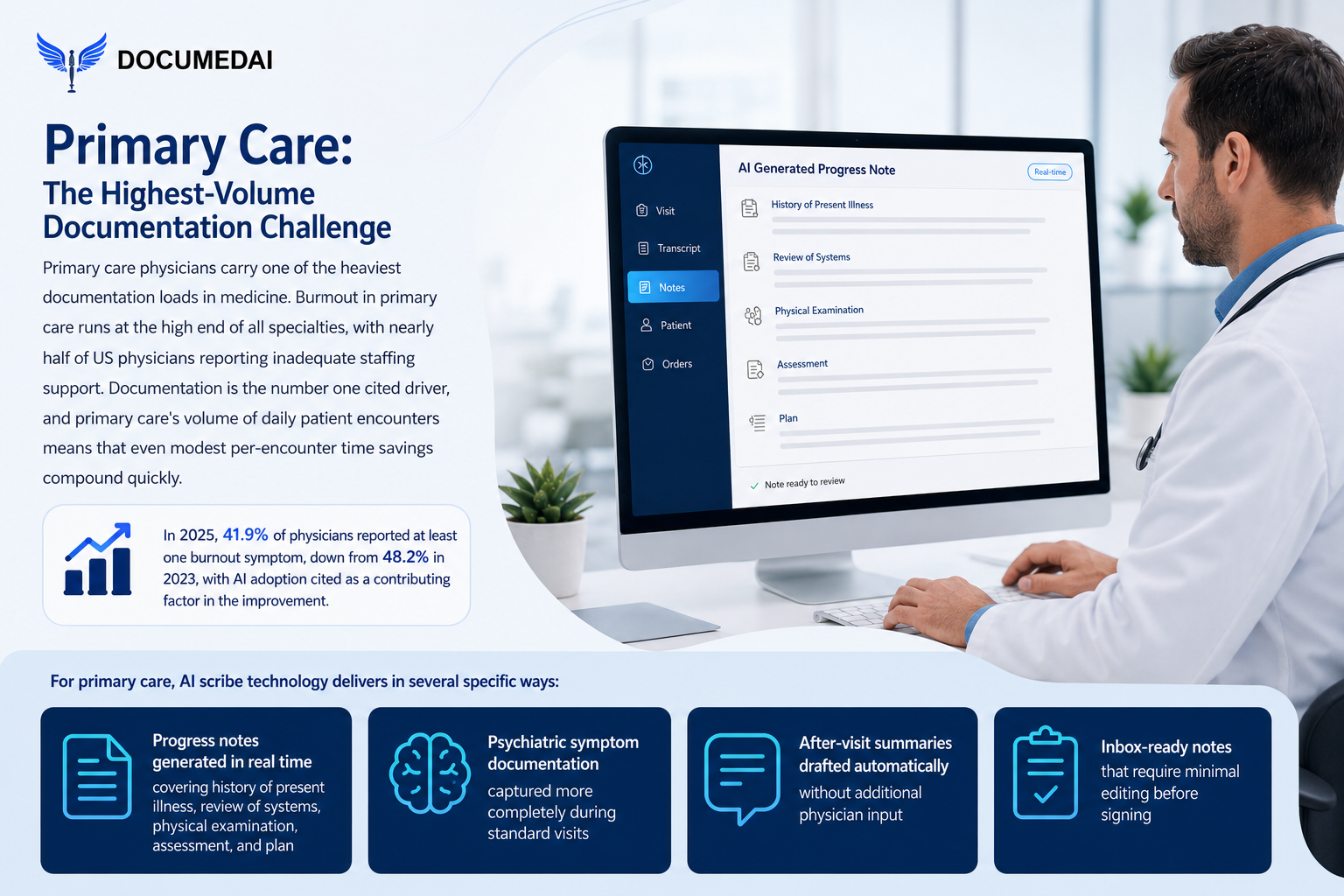
Primary care physicians carry one of the heaviest documentation loads in medicine. Burnout in primary care runs at the high end of all specialties, with nearly half of US physicians reporting inadequate staffing support. Documentation is the number one cited driver, and primary care's volume of daily patient encounters means that even modest per-encounter time savings compound quickly.
In 2025, 41.9% of physicians reported at least one burnout symptom, down from 48.2% in 2023, with AI adoption cited as a contributing factor in the improvement.
For primary care, AI scribe technology delivers in several specific ways:
A longitudinal study of primary care clinicians across outpatient settings found measurable reductions in documentation time and after-hours charting within weeks of AI scribe adoption. PubMed Central
The family medicine and internal medicine physicians who adopt AI scribes consistently and early also tend to see the greatest efficiency gains. The tool adapts to individual documentation style over time, making each successive note faster to review and finalize.
Cardiology documentation has little room for ambiguity. A note that says a patient has "some heart valve issues" is not clinically useful. The precise characterization of valve morphology, hemodynamic measurements, arrhythmia classification, and ejection fraction all carry diagnostic and billing weight.
This is where specialty-specific AI documentation earns its place. Cardiology notes hinge on precise hemodynamic detail, arrhythmia characterization, and valve findings, making generic note templates insufficient for this specialty's documentation requirements.
AI scribes trained on cardiology-specific terminology understand the clinical vocabulary of the specialty. They distinguish between valve stenosis and regurgitation, capture rhythm interpretation language accurately, and structure the note to reflect cardiology encounter formats rather than repurposing a generic SOAP structure.
For cardiologists, the value extends to:
DocuMed AI's 100+ customizable templates include cardiology-specific formats, covering consultations, follow-up visits, procedure documentation, and specialist correspondence.
Neurology sits at the more complex end of the documentation spectrum. A single encounter may involve a detailed neurological examination across multiple systems, nuanced history-taking for episodic conditions like migraine or epilepsy, and clinical reasoning that connects disparate findings into a diagnostic impression.
Specialty-trained AI models for neurology require terminology understanding and workflow-specific templates that go beyond what general-purpose transcription tools provide.
Among the 15 medical specialties studied in the Doximity 2026 report, neurologists reported the highest AI adoption rate at 64%. That is not a coincidence. Neurologists face long, cognitively demanding encounters and documentation complexity that makes manual charting particularly burdensome.
AI scribe technology addresses neurology documentation by:
The randomized clinical trial data supports the outcome. A randomized trial of ambient AI scribes in clinical practice, including a neurology department at the David Geffen School of Medicine at UCLA, found that ambient AI scribes produced measurable reductions in documentation burden and burnout.
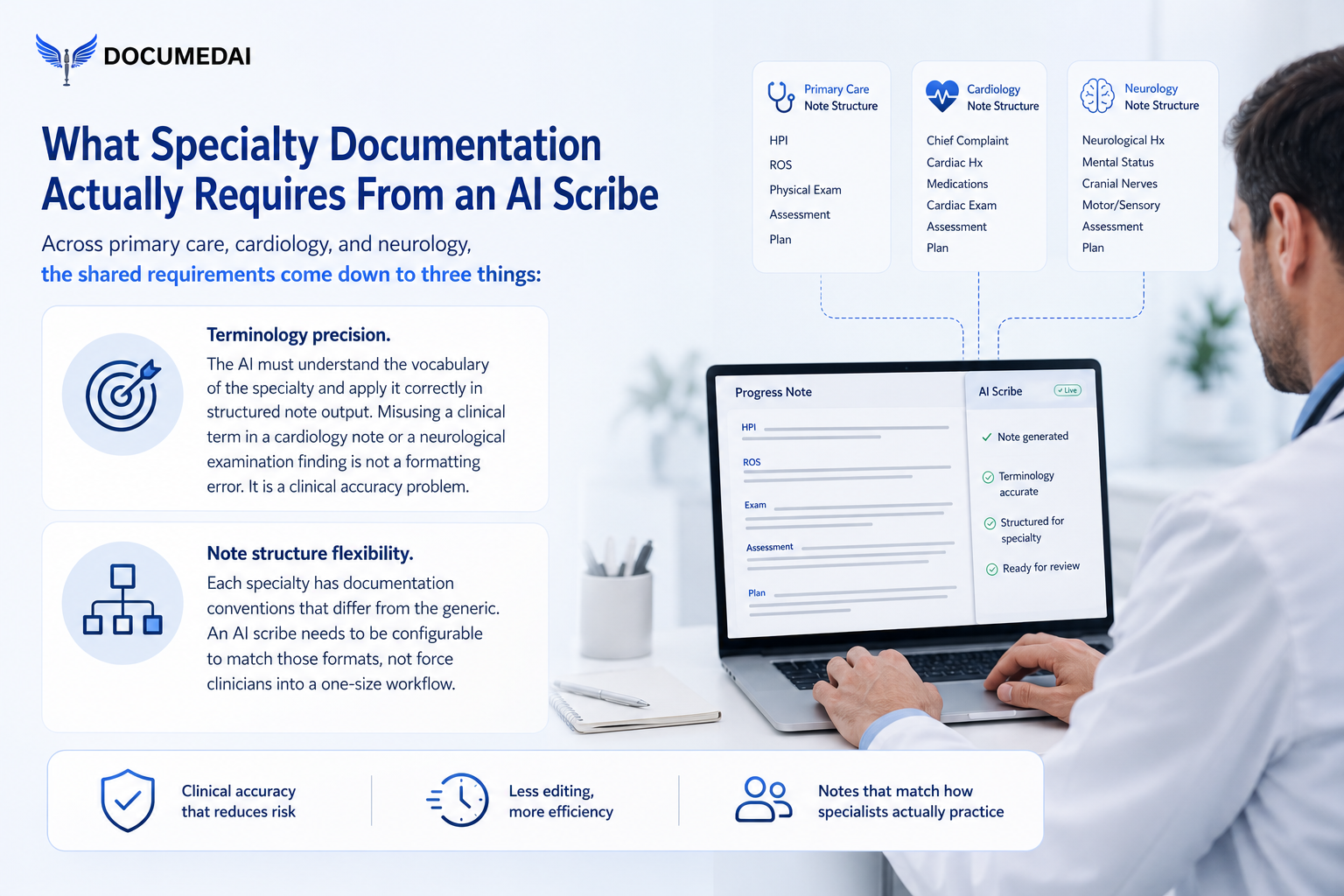
Across primary care, cardiology, and neurology, the shared requirements come down to three things:
Terminology precision. The AI must understand the vocabulary of the specialty and apply it correctly in structured note output. Misusing a clinical term in a cardiology note or a neurological examination finding is not a formatting error. It is a clinical accuracy problem.
Note structure flexibility. Each specialty has documentation conventions that differ from the generic. An AI scribe needs to be configurable to match those formats, not force clinicians into a one-size workflow.
Template depth beyond progress notes. Cardiology produces consultation reports. Neurology generates imaging referrals and seizure action plans. Primary care produces an enormous volume of letters, referrals, and after-visit summaries. The right AI scribe supports the full documentation scope of the specialty, not just the visit note.
DocuMed AI was built by practicing physicians and supports all three of these requirements across every specialty it serves.
The case for a single AI documentation platform that spans multiple specialties is not just about convenience. For group practices and multi-specialty clinics, it means one system, one onboarding process, one vendor relationship, and consistent documentation quality across the clinical team.
DocuMed AI serves primary care, cardiology, neurology, and more than a dozen other specialties from a single platform. The free trial requires no training. The notes it produces on day one are ready to review.
Enjoy clinical practice again without the administrative burden. Start your free trial of DocuMed AI today.
SIGN UP NOWSubscribe to Our Newsletter for the Latest in Healthcare Innovation
.png)
DocuMed AI leverages advanced AI Scribe GPT technology to convert ambient sounds and physician-patient conversations into professional medical notes, seamlessly formatted for electronic medical records (EMRs).


.png)

.png)
.png)