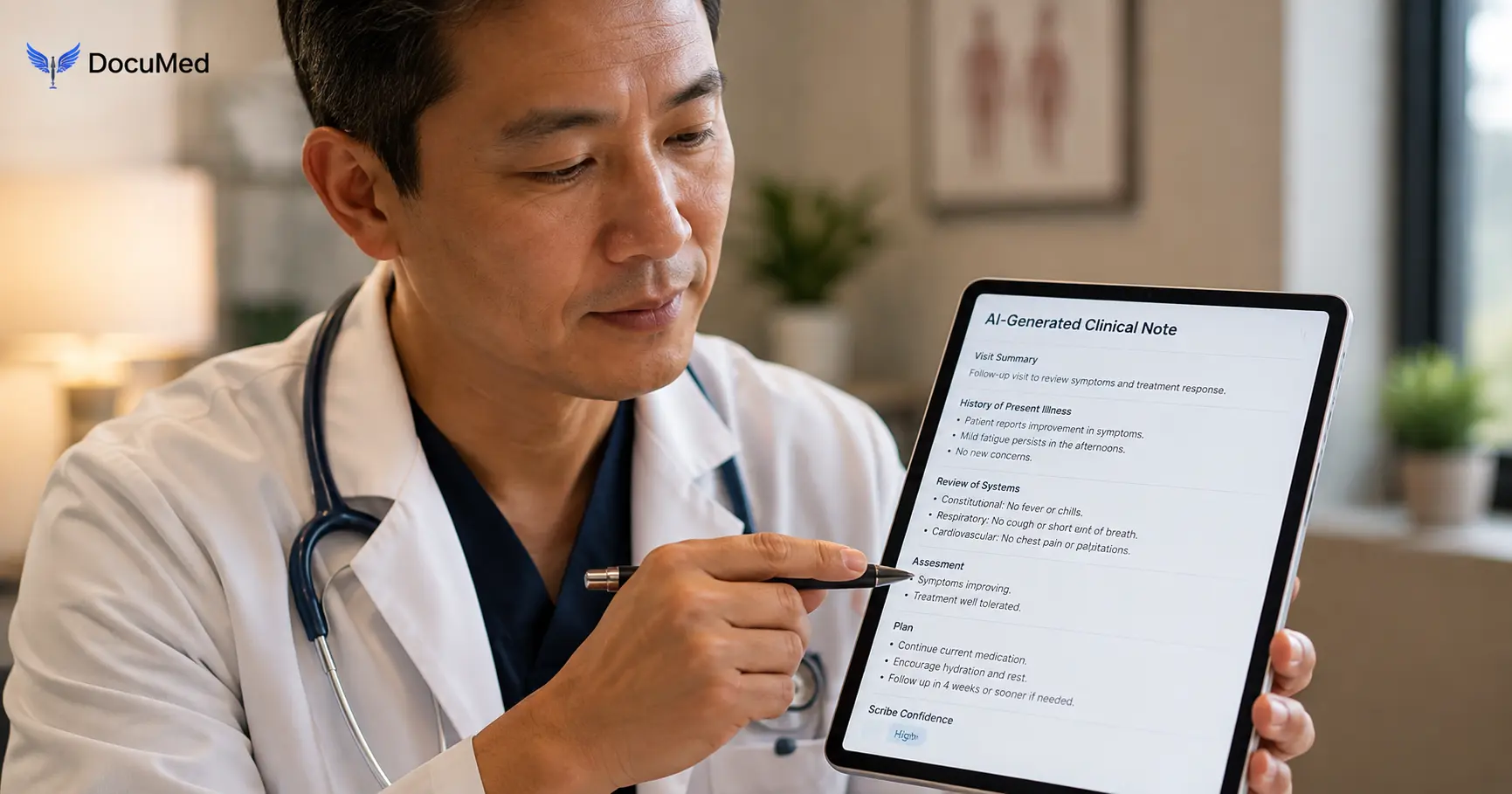
AI medical scribes can be highly accurate at turning a clinical conversation into a structured note, but "accurate" is not one number. It depends on what you're measuring: how correctly the words spoken were captured, how faithfully the generated note reflects what actually happened in the visit, and how reliable any attached coding suggestions are. DocuMed AI reports 99%+ clinical accuracy in its own testing, and like every credible AI scribe on the market, that figure assumes the clinician reviews and edits the note before it goes anywhere near a chart. If a vendor promises a perfect note with zero oversight, treat that as a warning sign, not a selling point.
Ask an AI scribe vendor "how accurate is your tool?" and you'll usually get a single percentage back. That number is only useful once you know which layer of the process it describes. There are three distinct kinds of accuracy at play, and a scribe can be strong at one and weaker at another.
A tool can transcribe words almost perfectly and still produce a note that misrepresents the visit, because note generation involves summarizing, structuring, and interpreting, not just transcribing. That's why clinical note fidelity, not raw transcription accuracy, is the number that matters most when you're evaluating whether an AI scribe is trustworthy.
Every tool built on speech recognition and language models makes mistakes sometimes. Knowing where those mistakes tend to originate is more useful than chasing a single accuracy claim, because it tells you what to watch for in your own documentation.
None of these failure modes are unique to AI. Human scribes and dictation transcriptionists mishear words and drop details too. The difference is that an AI scribe produces a full structured note in seconds, which means errors can compound across an entire note before a clinician ever sees it, making the review step even more important than it is with a slower, human-mediated process.
Physicians already spend roughly two hours on EHR and desk work for every hour of direct patient care, based on time-motion research published in the Annals of Internal Medicine (Sinsky et al., 2016). That imbalance is the entire reason AI scribes exist. But it also means an AI scribe's output has to be genuinely reliable, because if the review step takes as long as writing the note from scratch, the tool hasn't actually saved anyone anything.
That's why every legitimate AI scribe workflow, including DocuMed AI's, is built around what's often called physician-in-the-loop design. The clinician conducts the visit normally, the audio is securely transcribed, and a structured note appears within seconds. But the clinician still reviews, edits, and customizes that note before it goes anywhere. Only after that review does the clinician copy the finished note and paste it into whatever EHR or EMR the practice uses. No AI scribe should auto-file a note into a patient's chart without that review step, and no clinician should treat the AI output as a final answer rather than a strong first draft. You can see each step of that workflow laid out in detail on the DocuMed AI how it works page.
This isn't a limitation to tolerate. It's the safeguard that makes the accuracy numbers meaningful in the first place. A 99%+ accuracy claim describes a system where AI generation and clinician judgment work together, not a system where AI operates unsupervised.
Review catches what gets through, but the goal is to minimize how much needs catching. A few design choices make a measurable difference in how often an AI scribe gets things wrong before a clinician ever opens the note.
Specialty-specific templates matter more than they might seem to. A cardiology follow-up, a psychiatry intake, and an emergency medicine encounter have different structures, different vocabulary, and different things that count as clinically relevant. A scribe with a single generic note format is more likely to produce the over-generalized, templated language described above, because it's forcing every encounter into the same shape. A scribe with a large library of customizable templates, matched to specialty and visit type, produces notes that are structured the way that specialty actually documents, which reduces both omissions and vague filler.
Structured output helps too. When a note is broken into discrete sections rather than one long paragraph, it's much easier for a clinician to spot-check each part quickly during review, and easier for the underlying model to keep information organized rather than blending details together.
Finally, a scribe that adapts to an individual clinician's documentation style over time, learning preferred phrasing, typical assessment patterns, and how that clinician likes a plan section formatted, tends to produce notes that need fewer edits with continued use. That adaptation doesn't eliminate the need for review, but it narrows the gap between the AI-generated draft and what the clinician would have written unassisted, which is a meaningful contributor to overall documentation accuracy and to broader clinical documentation improvement efforts within a practice.
Accuracy claims from any vendor are worth testing against your own encounters rather than taking at face value. A free trial is the right place to do that before committing a practice to a new workflow. A few concrete checks:
If you're comparing more than one tool, it's worth weighing accuracy alongside the other factors that determine day-to-day fit, such as specialty coverage, EHR workflow, and pricing. Our guide to choosing the best AI medical scribe walks through that fuller comparison if accuracy is one criterion among several you're weighing.
DocuMed AI reports 99%+ clinical accuracy, and that figure reflects the same principles described above: secure, encrypted transcription of the visit, note generation built on specialty-specific templates and custom assessment styles, and a mandatory clinician review and edit step before anything leaves the platform. The tool learns an individual clinician's documentation style over time, which is designed to reduce the gap between the first draft and the note the clinician actually wants. Automated coding suggestions for E/M, CPT, and ICD-10 are presented for the clinician to verify, not applied automatically. Audio and note data are handled under enterprise-grade encryption with BAAs available, which matters for accuracy indirectly too: a platform built to enterprise security standards is a platform built with the kind of rigor that also supports reliable output. For more on how patient data is protected end to end, see our breakdown of what a HIPAA compliant AI scribe actually requires.
None of this replaces the clinician's own review. It's designed to make that review fast: a strong, specialty-appropriate first draft that usually needs edits rather than a rewrite.
Yes. Because note generation involves summarizing and structuring a conversation rather than just transcribing it word for word, an AI scribe can occasionally add a detail, such as an exam finding or a symptom, that wasn't actually stated during the visit. This is one of the most important reasons every AI-generated note needs a clinician's review before it's used, and it's why spot-checking for unstated findings should be part of how you evaluate any AI scribe during a trial.
Yes, every time. No AI medical scribe, including DocuMed AI, is designed to replace clinician judgment or file a note without review. The workflow is built around the clinician reviewing, editing, and customizing the AI-generated draft before copying it into the EHR. Treat the AI output as a strong first draft, not a finished chart entry.
Accuracy varies by vendor and by which layer of accuracy you're measuring: transcription, note fidelity, or coding suggestions. DocuMed AI reports 99%+ clinical accuracy in its own testing. Rather than relying on any vendor's stated number alone, test the tool against your own encounters during a free trial to see how it performs on your specific specialty and documentation style.
It can. Visits with dense, specialty-specific terminology, multiple speakers, background noise, or less common accents can be more challenging for any speech-to-text system. This is why specialty-specific templates and vocabulary matter, and why it's worth testing an AI scribe on the specific visit types and speech patterns you encounter regularly rather than assuming general performance will translate directly to your setting.
The clinician catches it during the review and edit step before the note goes anywhere. This is exactly why the review step is built into the workflow rather than treated as optional: it's the point at which a mishearing, an omission, or a hallucinated detail gets corrected before the note is copied into the patient's chart.
The clearest way to judge AI scribe accuracy is to test it against your own visits rather than a vendor's marketing claims. Start a free trial of DocuMed AI and spot-check the notes it generates against your next few encounters.
Enjoy clinical practice again without the administrative burden. Start your free trial of DocuMed AI today.
SIGN UP NOWSubscribe to Our Newsletter for the Latest in Healthcare Innovation
.png)
DocuMed AI leverages advanced AI Scribe GPT technology to convert ambient sounds and physician-patient conversations into professional medical notes, seamlessly formatted for electronic medical records (EMRs).


.png)

.png)
.png)