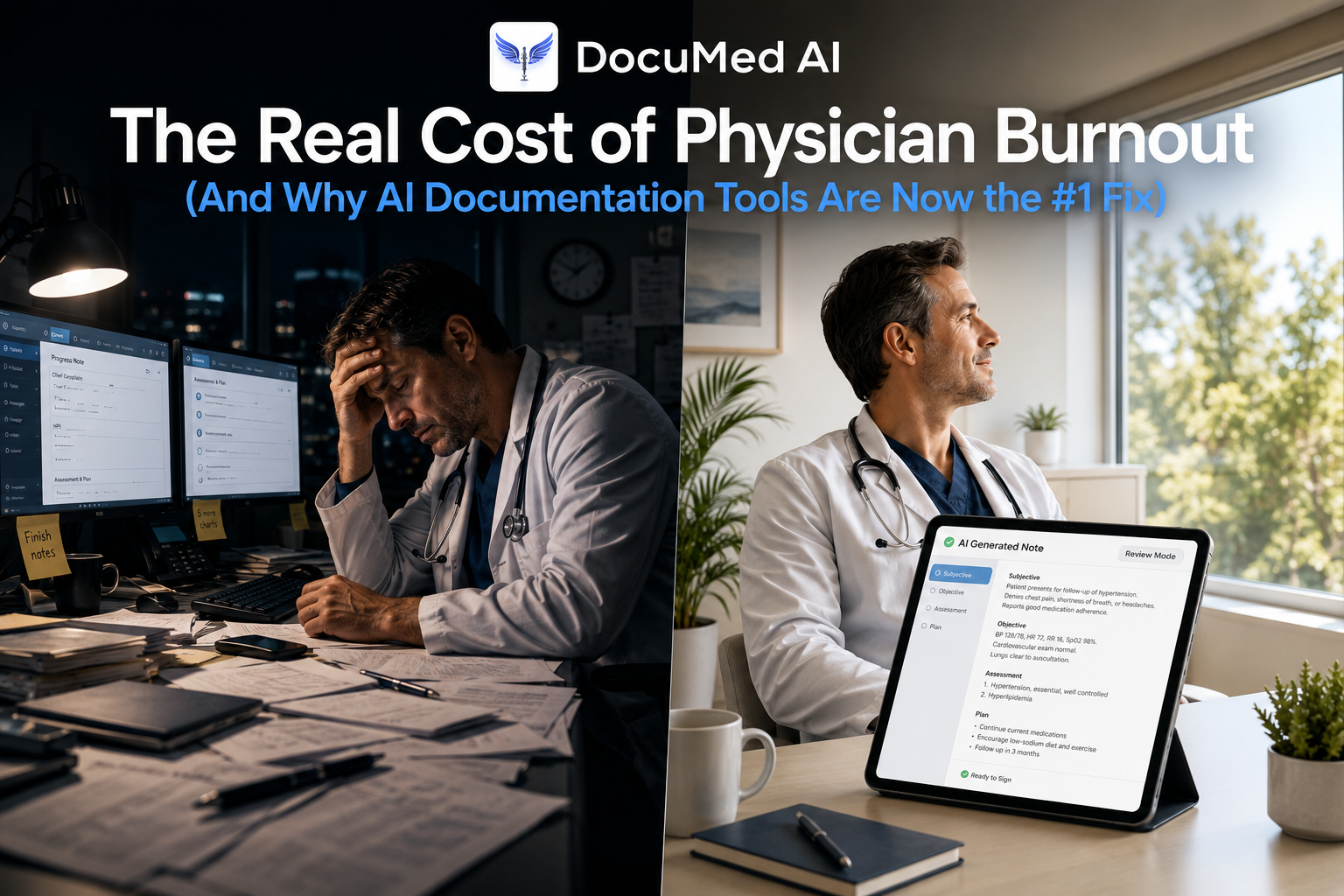
Physician burnout is frequently discussed as a mental health crisis. That framing is accurate, but it is incomplete.
Burnout is also a financial crisis, a patient safety crisis, and a workforce sustainability crisis. When the number behind each of those categories becomes visible, the conversation shifts from "how do we support struggling physicians" to "how do we fix the conditions that are causing this."
The conditions are well documented. The primary driver is not patient volume, clinical complexity, or the demands of the work itself. It is paperwork.
Physician burnout costs the US healthcare system an estimated $4.6 billion annually, largely driven by physician turnover and reduced work hours. The cost of replacing a single burned-out physician ranges from $500,000 to $1 million per departure, depending on specialty.
That figure exists because of a documentation problem. Solving the documentation problem is now the most direct route to addressing the cost.
The data on physician burnout in 2026 is both encouraging and sobering in the same breath.
In 2025, 41.9% of physicians reported at least one burnout symptom, down from 48.2% in 2023, the lowest rate recorded since before the COVID-19 pandemic. Progress is real. But four in ten physicians experiencing burnout is not a problem approaching resolution. It is a problem that has been partially contained while its underlying cause remains structurally intact.
Of the average 57.8 hours a week that physicians work, only 27.2 hours are spent on direct patient care. Physicians spend 13 hours on indirect care tasks including documentation and referrals, and another 7.3 hours on administrative work like prior authorizations and insurance forms.
That math means that for most physicians, nearly half of the working week is spent on work that has nothing to do with the clinical judgment that eight years of medical training was meant to develop.
Documentation is the top cause of physician burnout. A single documentation task can require 346 mouse clicks across 43 screens. Patient history lives in one module, medications in another, notes in yet another.
The EHR was not designed to reduce physician workload. In many respects, it increased it.
The aggregate statistics make the scale visible. But what documentation burden costs physicians happens at the level of individual days.

A primary care physician seeing 20 patients in a day does not complete their documentation during the appointments. Most finish their notes in the gaps between patients, or after clinic ends, or after dinner, or on Sunday morning before the week starts again.
For every hour of direct patient care, physicians spend roughly two additional hours on EHR data and documentation tasks. Physicians often spend 5.8 hours in the EHR for every 8 hours of scheduled patient care, with 1 to 2 hours of additional administrative work extending beyond the workday.
This is the phenomenon clinicians call "pajama time," and it has a direct relationship with both burnout and attrition. Physicians who consistently document after hours report lower job satisfaction, reduced sense of purpose in clinical work, and higher intent to reduce their hours or leave medicine.
Physicians remain 82.3% more likely to experience burnout than other US workers after adjusting for age, gender, relationship status, and work hours. The adjustment is important. It means the burnout differential is not explained by physicians simply working more. It is explained by the nature of the administrative load they carry on top of clinical work.
Several approaches to reducing physician burnout have been studied and implemented over the past decade. Mindfulness programs, schedule restructuring, peer support groups, wellness initiatives. These matter, and they help at the margins. They do not address the source.
70% of physicians see AI as a tool to automate tasks that contribute to work-related burnout. In 2026, more than three-quarters of physicians believe AI improves their ability to care for patients, up from 65% in 2023.
The physician workforce has arrived at a clear consensus position: AI documentation tools are the primary lever for reducing burnout at the source. Not as a supplement to wellness programs, but as the structural fix that documentation burden requires.
The research supports that position.
A Yale-led study published in JAMA Network Open tracked 263 physicians and advanced practice providers across six US health systems over 30 days. Burnout dropped from 51.9% to 38.8%. Physicians also spent less time charting after hours and felt more focused on patients during visits. A separate study of more than 1,400 clinicians at Mass General Brigham and Emory Healthcare found burnout fell from 50.6% to 29.4%, and that improvement was sustained.
These are peer-reviewed outcomes from large, multi-site studies. They are not vendor claims. A 13-point drop in burnout prevalence within 30 days of AI scribe adoption is a clinically meaningful result.
Time is the primary outcome. But what physicians do with the recovered time matters as much as the time itself.
90% of surveyed physicians believe AI can reduce after-hours work, with current users estimating it could cut pajama time nearly in half.
When documentation burden shrinks, several things tend to follow:
Patient visit quality improves. Physicians who are not mentally tracking documentation debt during an encounter are more present with their patient. The interaction quality changes. Patients notice.
Cognitive load decreases. Clinical decision-making under documentation pressure carries a measurable cognitive cost. Removing that pressure improves the clarity physicians bring to clinical judgment.
Career longevity extends. Physicians who leave medicine early due to burnout are not making a values choice. They are reaching a threshold of unsustainability. Reducing the documentation load extends the threshold.
Physicians using AI scribes generated 1.81 additional relative value units and saw roughly one more patient per week, with no increase in claim denials, translating to approximately $3,044 in additional annual revenue annually. At a system level, that revenue effect multiplied across a burned-out physician workforce represents a substantial recovery. UCLA Health
AI adoption among physicians rose from 47% in early 2025 to 63% by early 2026, with voice-based documentation tools, including ambient scribes, being the fastest-growing clinical use case.
The physicians driving that adoption are not technology enthusiasts. They are clinicians who reached a point where the cost of the status quo exceeded the cost of change. That calculation is becoming easier to make as the tools become more accessible, more accurate, and more directly connected to measurable outcomes.
The burnout rate is declining for the first time in four years. AI documentation adoption is rising at the same rate that burnout is falling. That correlation is supported by the research, and it points toward a clear direction for practices still evaluating whether to act.
DocuMedAI is an ambient AI medical scribe built by practicing physicians. It captures patient encounters, generates structured clinical notes with accuracy above 99%, and supports a full template library covering referral letters, discharge summaries, after-visit summaries, and all documentation types beyond the progress note.
Most clinicians who adopt it recover approximately 40 hours per month that were previously absorbed by documentation. The free trial requires no training and is available to any practice ready to start.
The documentation burden that is driving physician burnout is fixable. The tools to fix it are available now.
Enjoy clinical practice again without the administrative burden. Start your free trial of DocuMed AI today.
SIGN UP NOWSubscribe to Our Newsletter for the Latest in Healthcare Innovation
.png)
DocuMed AI leverages advanced AI Scribe GPT technology to convert ambient sounds and physician-patient conversations into professional medical notes, seamlessly formatted for electronic medical records (EMRs).


.png)

.png)
.png)