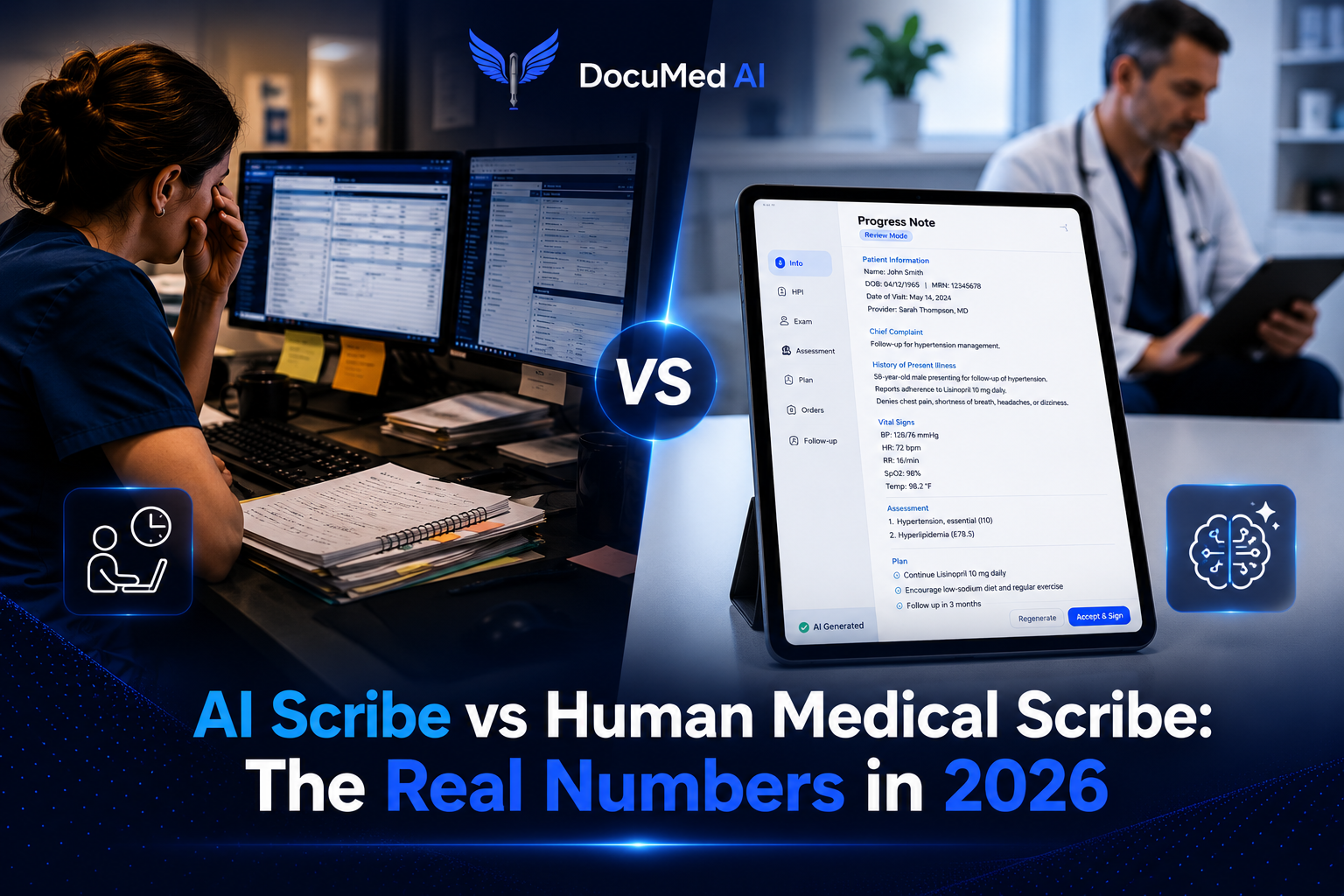
Most practices that hire a medical scribe do it for the right reasons. The physician is buried in documentation. Clinic time is bleeding into evenings. Something has to change.
The problem is that the math on human scribes rarely gets examined closely before the hire. The salary looks manageable on paper. The total cost does not.
Average turnover for medical scribes exceeds 40% annually, meaning practices are likely repeating recruitment and training costs every one to two years. That is not a staffing inconvenience. It is a structural cost that compounds every time a scribe leaves.
AI scribes have reached a level of clinical accuracy and workflow maturity that makes this a genuine decision, not a forced comparison between a proven solution and an immature one. This article puts the real numbers side by side so practices can make the choice with full information.
The advertised cost is the salary. The actual cost is considerably higher.
The average salary for a medical scribe in the United States is $56,298 per year according to Glassdoor data as of June 2026, with the typical range sitting between $44,251 and $71,972 annually. Salary.com puts the median closer to $41,129, reflecting variation by location and experience level.
That base figure is the starting point, not the ceiling.
Hidden costs beyond the advertised salary are significant and include recruitment fees, extensive training and onboarding time, employee benefits which can add 20 to 30 percent to the salary, management overhead, and equipment costs.
A fully loaded human scribe covering a single provider runs $4,459 to $6,264 per month, which accounts for salary, benefits, and overhead. That is $53,000 to $75,000 annually before factoring in the cost of replacing them.
Human scribes carry a 25 to 35 percent annual turnover rate, and replacing a scribe costs anywhere from 50 to 150 percent of their yearly salary. A practice that has had the same scribe for three years has been fortunate. A practice that has had three scribes in three years has paid for the position multiple times over.
Training costs per scribe range from $600 to $3,000 for formal programs, with some comprehensive certifications approaching $4,000. That cost resets every time a scribe departs.
The pricing structure for AI scribes is simpler and more predictable.
Most AI medical scribe tools operate on a subscription model, with costs typically ranging from $99 to $299 per month per provider. Research by AAFP estimates the cost of AI-powered scribes at around $150 to $200 per month.
No benefits. No training investment that walks out the door. No turnover cycle. No recruitment fees. No onboarding lag while a new hire learns the physician’s preferences and specialty terminology.
At $1,188 to $3,588 per year for AI versus $35,000 to $70,000 for a human scribe, even at the high end AI documentation is roughly 90 percent cheaper.
The per-note economics reinforce that gap. If a practice sees 100 patients a week and pays $199 per month for AI documentation, the cost per note is $0.46. A human scribe at $40,000 per year handling the same volume costs $7.69 per note.
The comparison below summarizes how a human medical scribe and an AI medical scribe differ across the factors that most affect a practice.
Scheduling gaps. A human scribe is unavailable when sick, on leave, or when scheduling conflicts arise. The physician documents alone on those days, absorbing the full administrative load without notice.
Onboarding time. Experienced scribes develop an understanding of their provider’s preferences that takes months to build. They anticipate what the provider wants documented and how. Every time a scribe leaves, that institutional knowledge resets. The physician spends weeks correcting notes while a new hire learns their workflow.
Productivity drag during transition. When a scribe departs, the practice does not pause. The physician absorbs the documentation load while recruiting, interviewing, and onboarding a replacement. That window can run six to twelve weeks.
Inconsistency across encounters. Human scribes vary in quality, speed, and accuracy. A note produced at 8am by a rested scribe is not always the same quality as one produced at the end of a 20-patient afternoon session. AI produces consistent output at the first encounter and the fortieth.
This comparison is not one-sided in every dimension. Human scribes offer capabilities that AI does not fully replicate in certain contexts.
Human scribes can provide workflow assistance beyond documentation, pulling up prior records, queuing orders, and preparing referral letters. They function as a clinical assistant, not just a note-taker. A human scribe can also notice when a provider forgot to ask about allergies and prompt them. AI scribes document what happens but do not influence the encounter.
For complex procedure documentation, during lengthy surgical procedures or complex interventional cases, a human scribe tracking the action in real time may outperform ambient AI, especially in noisy environments.
For the majority of outpatient encounters across primary care, cardiology, neurology, psychiatry, and most ambulatory specialties, those advantages do not change the cost calculus. The documentation complexity in standard outpatient settings is well within what AI handles accurately and consistently.
The cost comparison is only part of the picture. AI scribes also generate revenue.
By automating documentation, AI scribes free physicians from hours of administrative work each day. Physicians can save two to three hours daily, which can translate into seeing more patients and potentially increasing annual revenue by $125,000 to $200,000 per doctor.
A UCSF study found that physicians using AI scribes generated 1.81 additional relative value units and saw roughly one more patient per week, with no rise in claim denials, translating to approximately $3,044 in additional annual revenue per physician. That figure is likely conservative relative to what full adoption delivers.
Most practices that switch to DocuMed AI recover the annual subscription cost within the first month of additional patient capacity.
The honest answer depends on practice type, encounter complexity, and what the physician needs from documentation support beyond the note itself.
For most outpatient practices evaluating a medical scribe alternative in 2026, the numbers point clearly toward AI documentation. The cost difference is not marginal. AI solutions reduce costs by 60 to 75 percent compared to human scribes while improving efficiency, with practices saving up to $1 million annually from reduced errors and increased efficiency at scale.
For solo and small practices especially, the calculus is straightforward. A full-time human scribe costs more than most independent practices can justify per provider. An AI scribe at $99 to $299 per month, producing notes across all document types with 99%+ accuracy, delivers more documentation capability at a fraction of the cost, with no HR overhead and no turnover risk.
DocuMed AI is available on a free trial, no training required. The note it produces at your first session is the quality you can expect at every session after it.
Enjoy clinical practice again without the administrative burden. Start your free trial of DocuMed AI today.
SIGN UP NOWSubscribe to Our Newsletter for the Latest in Healthcare Innovation
.png)
DocuMed AI leverages advanced AI Scribe GPT technology to convert ambient sounds and physician-patient conversations into professional medical notes, seamlessly formatted for electronic medical records (EMRs).


.png)

.png)
.png)