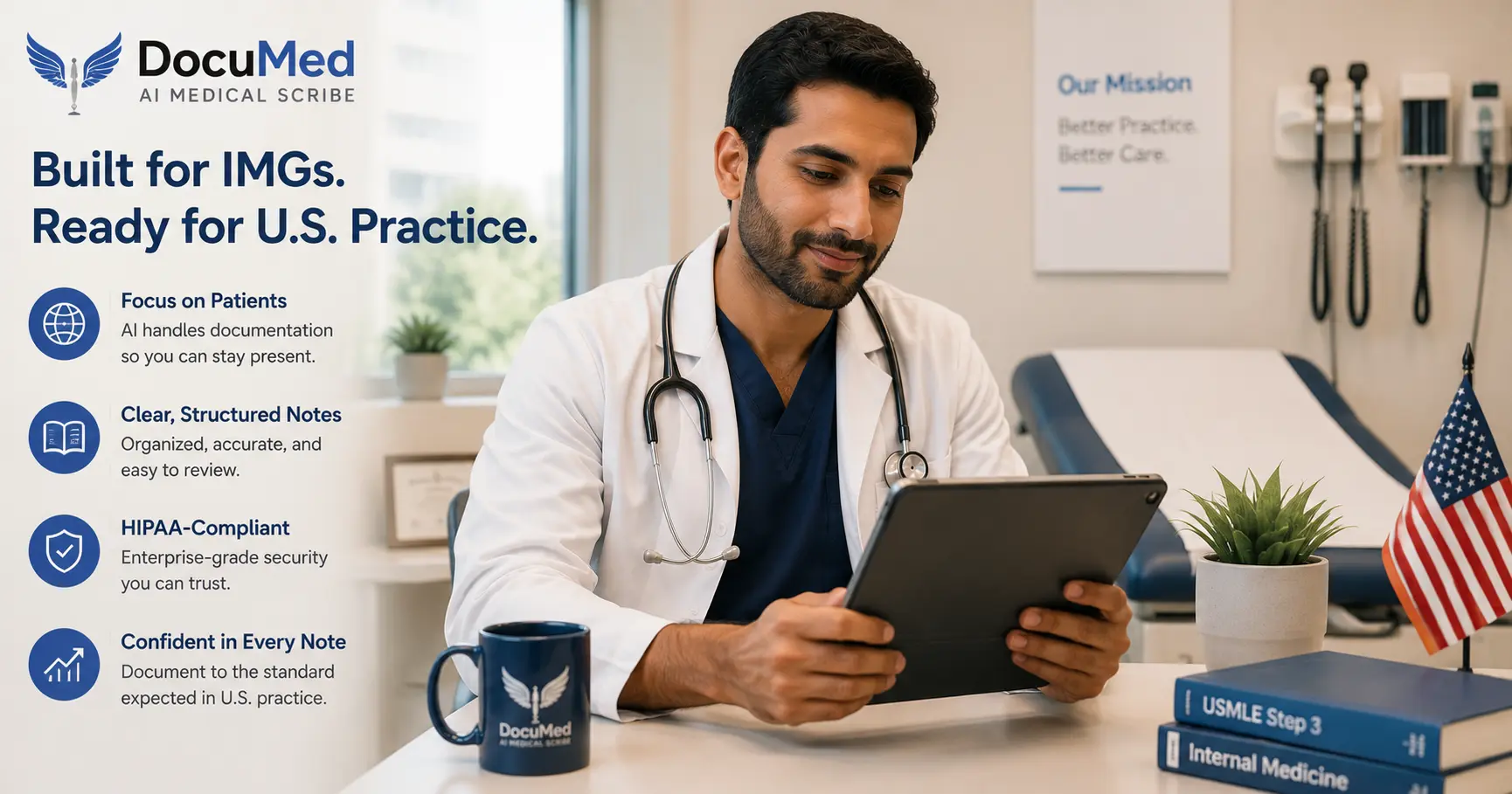
An AI medical scribe like DocuMed AI listens to the visit, or transcribes an uploaded recording, and generates a structured clinical note in a US-standard format within seconds. For international medical graduates (IMGs), that draft note reflects the structure, terminology, and organization that US residency programs and practices expect, giving the clinician a consistent starting point to review, edit, and finalize in their own words. The clinician stays fully in control: DocuMed AI does not file the note anywhere on its own, it produces a draft the physician reviews before it goes into the chart.
This matters because much of what IMGs encounter when they start practicing in the US is not a knowledge or competence problem. It is a systems problem. US documentation conventions, billing-linked note structure, and EHR habits differ from what many IMGs trained on elsewhere, and those differences show up hardest during the exact period, residency and early independent practice, when time is already scarce. IMGs bring years of clinical training and, often, prior independent practice experience. What changes on arrival in the US is the documentation system around that training, not the clinical skill underneath it.
Several specific friction points come up repeatedly for physicians who trained outside the US and are adapting to American clinical documentation. None of these reflect clinical ability. They reflect unfamiliarity with a new system, and that unfamiliarity fades with exposure, but it costs real time in the meantime.
US clinical notes tend to follow specific structural conventions, SOAP format, problem-oriented charting, templated review of systems, that vary by specialty and setting but are broadly consistent within a given health system. Physicians trained in other countries often used different note formats, different levels of granularity, or different emphasis on subjective versus objective findings. Learning the expected shape of a US note, on top of a new clinical environment, adds a layer of adjustment that has nothing to do with clinical judgment.
Evaluation and Management (E/M) documentation in the US is tied directly to billing level and medical necessity. The note has to support the level of service coded, which means specific elements, history, exam findings, medical decision-making, need to be present and clearly documented. This billing-linked documentation model is distinct from many other countries' clinical charting practices, and getting it right takes deliberate, focused learning rather than intuition.
US notes also function as legal and risk-management documents. Phrasing around informed consent, differential diagnosis reasoning, and follow-up instructions carries specific conventions that protect both the patient and the clinician. Standard phrases for documenting shared decision-making, capacity, and patient education exist for a reason, and knowing which ones a given institution expects is a learned skill, not something that transfers automatically from another country's medico-legal system. Adapting to this system means learning a new documentation dialect, not acquiring a new level of clinical reasoning.
Every EHR has its own click patterns, templates, and shortcuts, and most US employers use systems that IMGs have not touched before arriving. Learning where to click and how a given EHR structures a note is a separate skill from learning what to write, but the two get tangled together, especially in the first months on the job.
Residency and early independent practice already carry a heavy documentation load for every physician, regardless of training background. Layer new-country administrative norms and an unfamiliar EHR on top of that baseline load, and after-hours charting compounds quickly. Broader research on physician time allocation, not specific to IMGs, underscores how significant this burden already is across US medicine: Sinsky et al. found that physicians spend roughly 49% of their office day on EHR and desk work compared to about 27% on direct patient care, close to two hours of documentation for every hour spent with patients.
For physicians who trained and practiced in a different language, composing precise, idiomatic clinical prose in English on the fly, in the middle of a fifteen-minute visit, adds cognitive load that has nothing to do with clinical skill. Finding the right English phrasing for a nuanced finding while also examining a patient is a genuinely different task than knowing what that finding means.
DocuMed AI is built around a simple workflow: the clinician records the visit, or uploads audio, the recording is securely transcribed, and a structured note appears within seconds. The clinician reviews, edits, and customizes that note before doing anything else with it, then copies the finished note and pastes it into whatever EHR the practice uses.
For IMG physicians specifically, that workflow offers a few practical advantages:
None of this changes who is responsible for the note. DocuMed AI does not connect directly into an EHR or auto-file documentation. The clinician copies the finished, reviewed note with one click and pastes it into any EHR, keeping physician judgment and physician review at the center of every chart. Learn more about the process on the How It Works page.
Yes. DocuMed AI includes automated coding suggestions for E/M levels, CPT codes, and ICD-10 codes alongside the generated note. Because E/M documentation in the US is billing-linked in a way that differs from many other countries' charting systems, having coding suggestions generated directly from the visit content gives IMG physicians a useful reference point while they build fluency with US coding conventions. The physician still reviews and confirms coding decisions; DocuMed AI's suggestions are a starting point, not a final determination. For a closer look at how the platform approaches this, see DocuMed AI's post on E/M coding and documentation.
DocuMed AI is physician-founded. That grounding shapes a product built around a straightforward principle: the clinician stays in control of the note, and the technology exists to reduce administrative burden, not to substitute for clinical judgment. Read more about the company on the About Us page.
DocuMed AI is used across a wide range of specialties and care settings, including primary care, endocrinology, cardiology, neurology, psychiatry, emergency medicine, and surgery, by physicians, nurse practitioners, physician assistants, and nurses, in hospitals, teaching hospitals, ambulatory surgery centers, outpatient clinics, multi-site networks, telehealth, and long-term care settings. Because the platform supports 100+ customizable templates and adapts to a clinician's documentation style over time, it fits residency programs and established community practices alike. See the full picture of who DocuMed AI serves.
No. AI scribes benefit physicians across every background. For IMGs, the value is less about English proficiency and more about adapting to US-specific note structure, billing-linked documentation requirements, and a new EHR, all while managing a full clinical schedule. The tool provides a consistent, US-style structural starting point that any physician new to the system can review and build on.
No. DocuMed AI produces a structured draft note that the clinician reviews, edits, and finalizes. It is designed to reduce the time and friction of documentation, not to remove physician judgment or eliminate the need to understand US clinical and billing standards. Physicians remain the author and final reviewer of every note.
No. DocuMed AI does not integrate directly or automatically file notes into an EHR. The clinician copies the finished, reviewed note with one click and pastes it into whatever EHR their practice or health system uses.
Yes. DocuMed AI generates automated coding suggestions for E/M levels, CPT codes, and ICD-10 codes from the visit content. These suggestions are a starting reference; the clinician reviews and confirms coding before it is used for billing.
DocuMed AI supports the full range of specialties, from primary care and cardiology to psychiatry and emergency medicine, across hospitals, outpatient clinics, telehealth, and long-term care settings, with 100+ customizable templates so note structure fits the specialty and setting.
If US documentation norms, E/M requirements, and after-hours charting are adding friction to your transition into US practice, an AI medical scribe can give you a consistent, reviewable starting point for every note. Sign up for free and see a structured note generated from your next visit, or request a demo to walk through the workflow with the team.
Enjoy clinical practice again without the administrative burden. Start your free trial of DocuMed AI today.
SIGN UP NOWSubscribe to Our Newsletter for the Latest in Healthcare Innovation
.png)
DocuMed AI leverages advanced AI Scribe GPT technology to convert ambient sounds and physician-patient conversations into professional medical notes, seamlessly formatted for electronic medical records (EMRs).


.png)

.png)
.png)