.png)
The progress note gets most of the attention in AI documentation conversations. It is the most visible output of a patient encounter and the most obvious target for automation.
But the progress note is not the only document a patient encounter generates.
Every referral requires a letter. Every hospitalization ends with a discharge summary. Every patient leaves with after-visit instructions. Every insurer requesting prior authorization needs clinical correspondence. Every specialist consultation generates a letter back to the referring provider.
A single specialist referral letter takes 15 to 20 minutes to compose, format, and send. Multiplied across dozens of referrals weekly, practices are spending 20 to 30 hours of staff time on clinical correspondence alone. PubMed Central
AI clinical letter automation is addressing this directly. The same encounter that generates a progress note can now produce a referral letter, a discharge summary, and an after-visit summary in the same session, without additional physician input.
The scope of what modern AI documentation platforms can generate from a single patient encounter is broader than most physicians realize when they first evaluate a tool.
Modern AI clinical documentation can generate progress notes and clinical summaries, referral letters to specialists, discharge summaries and care transition documents, patient education materials and after-visit instructions, medical certificates and work or school documentation, insurance correspondence and prior authorization requests, and prescription summaries and medication reconciliation documents. arxiv
The mechanism is the same across all of these. The AI captures the encounter, extracts clinically relevant content, and structures it into the appropriate document format. A referral letter needs a different structure than a discharge summary. An after-visit note for a patient needs different language than a consultation report for a specialist. The AI applies the right template to the right output without requiring the physician to manage the distinction manually.
DocuMed AI's library of over 100 customizable templates covers this full scope. Clinicians select the document types they need for a given encounter, and the AI generates them in parallel.
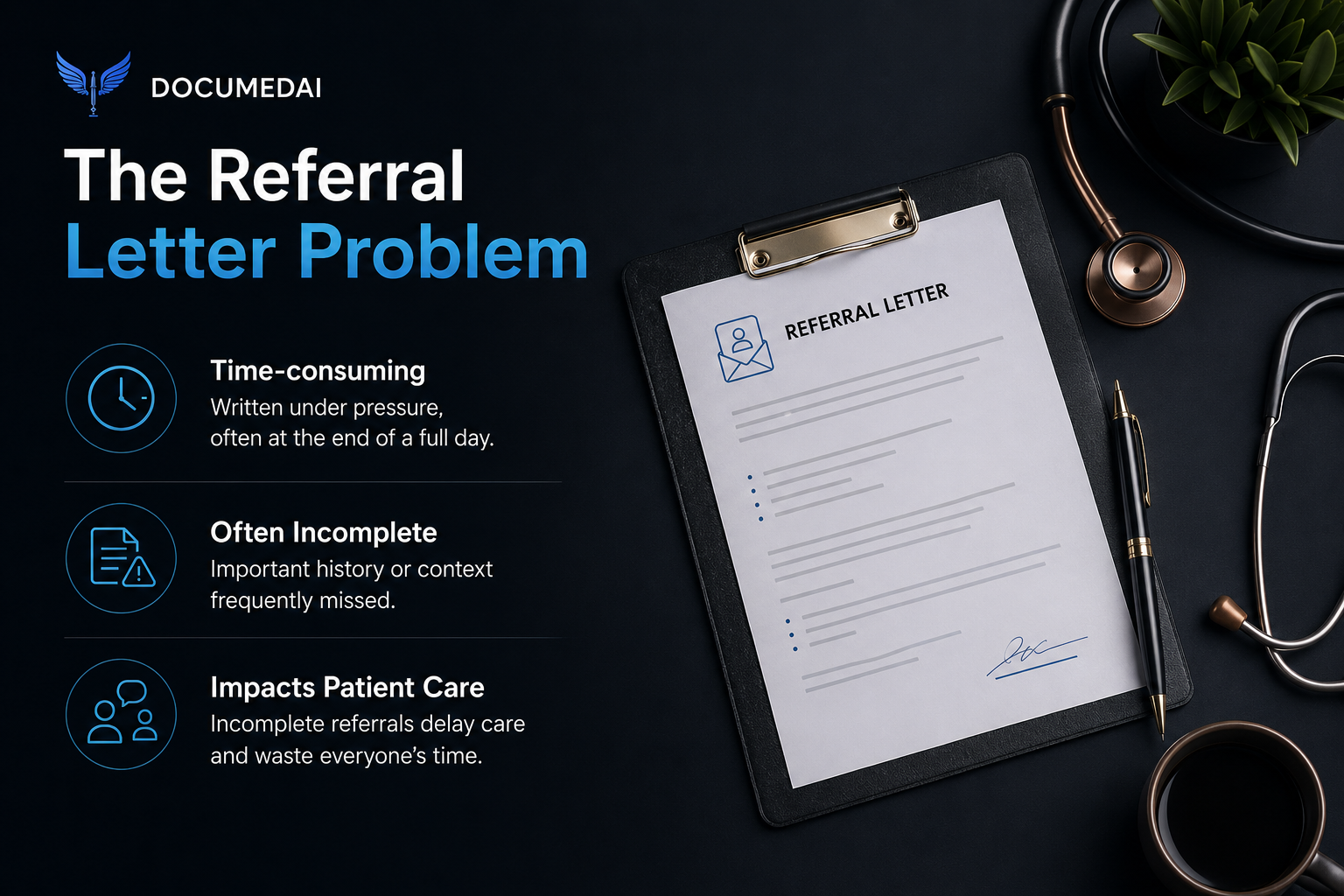
Referral letters are one of the most time-consuming and most underappreciated documentation tasks in ambulatory practice.
A good referral letter communicates the clinical reason for referral, the relevant history, current medications, recent investigations, and the specific question being asked of the specialist. Done well, it reduces the time a specialist spends reviewing a patient's chart before the appointment and improves the quality of the consultation. Done poorly, it delays care and wastes everyone's time.
Physicians who write these manually are doing it under time pressure, often at the end of a full clinic day, from memory or with fragmented reference to a chart. The result is frequently incomplete.
AI-powered automation extracts key details from the patient encounter and formats them into structured referral letters ready for review, ensuring consistency and reducing the risk of omissions or delays. DeepScribe
With an AI referral letter generator, the physician reviews and approves a complete, structured referral letter rather than writing one from scratch. This reduces time per document from 10 to 15 minutes for manual creation to 60 to 90 seconds for clinician review and approval. arxiv
Discharge summaries serve a different function from referral letters but carry equal clinical weight. They are the bridge between inpatient and outpatient care, between the hospitalist and the primary care physician, between the patient and any specialist who follows up afterward.
Incomplete or delayed discharge summaries are a documented patient safety risk. When a primary care physician does not receive a complete discharge summary before a patient's first post-hospitalization visit, clinical decisions get made without full information.
AI-generated discharge summaries summarize patient-clinician encounters and clinical notes into structured care transition documents, reviewed and edited by the clinician before distribution. The physician remains the author of record. The AI removes the time cost of converting encounter information into a structured document. medrxiv
The research on AI-generated discharge summaries shows that quality is competitive with manually written documents when the physician reviews and edits the output. Error rates in AI-generated drafts are low and manageable within a standard review workflow.
For hospitalists and inpatient physicians, automated discharge summary generation represents one of the highest-impact documentation time savings available. A hospitalist managing eight to twelve discharges per day can recover hours that would otherwise go to manual summary writing.
After-visit summaries serve a different audience than referral letters or discharge summaries. They are written for patients, not providers. They need to translate clinical language into accessible information, confirm what was discussed, summarize any new medications or changes, and provide clear follow-up instructions.
Physicians who write these manually are producing a second version of the same encounter, in plain language, under time pressure. Most practices either skip them or produce abbreviated versions that do not fully capture what the physician intended the patient to take away.
AI after-visit summary generation solves this by producing a patient-appropriate version of the encounter automatically alongside the clinical note. Same source material. Different output format. No additional physician input required.
AI clinical documentation systems can apply specialty-specific templates to generate multiple document types automatically from a single encounter, including progress notes, referral letters, patient summaries, after-visit instructions, and insurance documentation. arxiv
The workflow change for practices adopting AI clinical letter automation is less disruptive than most assume.
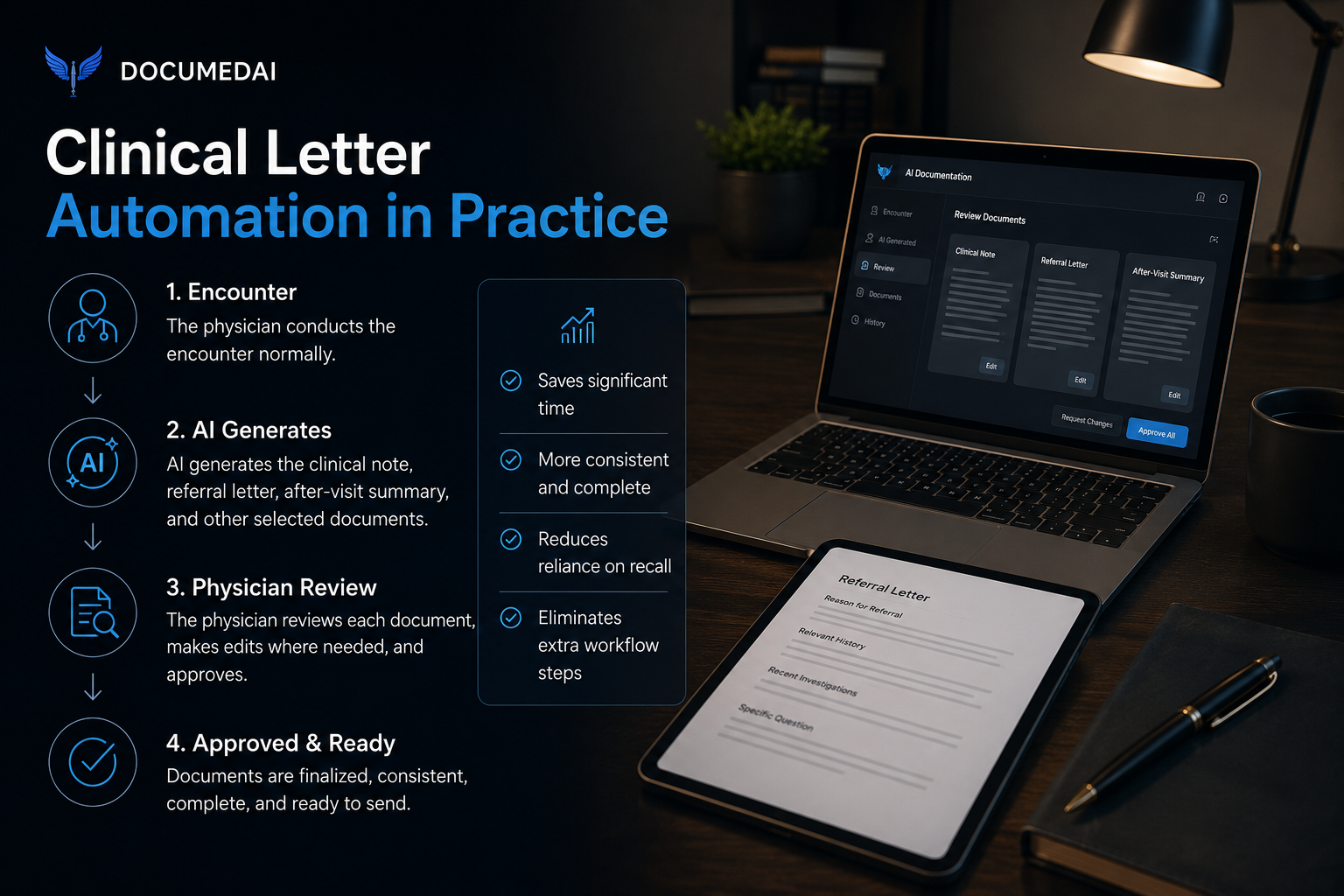
The physician conducts the encounter normally. The AI generates the clinical note, the referral letter, the after-visit summary, or whatever additional documents have been selected for that encounter type. The physician reviews each document, makes edits where needed, and approves.
The review step takes a fraction of the time that writing from scratch would have taken. The output is more consistent, more complete, and less dependent on the physician's recall of a specific encounter hours after it happened.
For practices that have traditionally used administrative staff to draft referral letters and correspondence from physician verbal instructions, AI automation removes a step from that workflow entirely. The physician reviews a draft rather than dictating a brief that then requires drafting, review, and revision.
DocuMed AI was built to cover the full documentation scope of clinical practice, not just the progress note. The 100+ template library includes referral letters for all common specialty destinations, discharge summary formats, after-visit patient summaries, prior authorization documentation, and specialist consultation letters.
All outputs are generated from the same encounter and reviewed through the same interface. HIPAA-compliant from audio capture through document export.
The free trial includes access to the full template library. Start with the documentation type that costs your practice the most time.
Enjoy clinical practice again without the administrative burden. Start your free trial of DocuMed AI today.
SIGN UP NOWSubscribe to Our Newsletter for the Latest in Healthcare Innovation
.png)
DocuMed AI leverages advanced AI Scribe GPT technology to convert ambient sounds and physician-patient conversations into professional medical notes, seamlessly formatted for electronic medical records (EMRs).


.png)

.png)
.png)